 Portsmouth Waterfront
we visited Portsmouth, one of the oldest towns in New England.
Portsmouth Waterfront
we visited Portsmouth, one of the oldest towns in New England.
New Hampshire continues to surprise us with its depth and breadth of spots to
visit. We've seen the lovely small Currier Museum in Manchester and yesterday
Portsmouth Waterfront
we visited Portsmouth, one of the oldest towns in New England.
This area was first settled in 1630 by a small group of Englishmen who, sailing up the Piscataqua River, were charmed by the thick growth of strawberry bushes along the sides of the river. They named their new town Strawbery Banke and it wasn't long before it became an influential commercial center, with wharves and merchants' shops and (later) shipbuilders established on the central streets -- Puddle and Dock. Surely there couldn't be more delightful names for any place!
In 1653 the new settlement was established under the laws of the Colony of
the Massachusetts Bay with the new, more dignified name of Portsmouth, and in 1679
 Strawbery Banke museum
New Hampshire became a royal colony with Portsmouth as its capital. Portsmouth
stood in the same rank as Boston, New York, and Philadelphia. Although the
capital moved inland, there was still enough tall virgin timber for ship's masts,
and the city continued to thrive, and developed into an early shipbuilding port.
The wealth of trade filled Portsmouth with colonial "mansion houses" -- the term
was generally used to describe anything with more than one room and one story.
Portsmouth merchants traded as far as Barcelona and Marseilles, and the waterfront
acquired the name of Puddle Dock.
Strawbery Banke museum
New Hampshire became a royal colony with Portsmouth as its capital. Portsmouth
stood in the same rank as Boston, New York, and Philadelphia. Although the
capital moved inland, there was still enough tall virgin timber for ship's masts,
and the city continued to thrive, and developed into an early shipbuilding port.
The wealth of trade filled Portsmouth with colonial "mansion houses" -- the term
was generally used to describe anything with more than one room and one story.
Portsmouth merchants traded as far as Barcelona and Marseilles, and the waterfront
acquired the name of Puddle Dock.
By the time of the Revolution, Portsmouth's shipping had diminished. A brief flurry of lucrative privateering ended after the War of 1812, and the Portsmouth Navy Yard, founded under President Jefferson in 1800, established the industry and the identity of the city ever since. Yet shipbuilding did not bring in nearly as much wealth as trade, and Portsmouth disappeared from the front rank of coastal settlements.
As a slow fog creeps over the ground, the historic Puddle Dock waterfront
of Portsmouth -- old Strawbery Banke -- sank into decay, ever so gradually. The
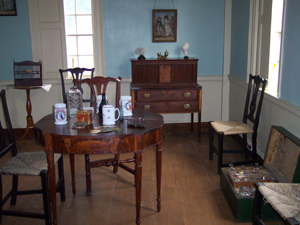 Colonial dining room
harbor was filled in, and by the early twentieth century the colonial merchants'
mansions had been subdivided into apartments for thousands of immigrant laborers.
Colonial dining room
harbor was filled in, and by the early twentieth century the colonial merchants'
mansions had been subdivided into apartments for thousands of immigrant laborers.
The Depression aborted an early effort at urban renewal, and before the project could be restarted Portsmouth was swept up in the urgency of war. The Navy Yard, which had launched the first U. S. submarine, the L-8, in 1917, built 75 more during WW II. And Puddle Dock remained filled with 17th and 18th century buildings, true to the New England tradition of "Use It All, Wear It Out, Make It Do or Go without."
After the war, federal funds became available for urban renewal, and Puddle
Duck, which had been a slum throughout the living memory of Portsmouth politicians,
was targeted for destruction. But the history of Portsmouth's colonial prosperity
was kept alive in -- of course -- the local library, and after librarian Dorothy M.
Vaughan gave the Rotary Club a piece of her mind in 1957, a voluntary organization,
 Child's Bedroom
Strawbery Banke, Inc. was formed to preserve at least a part of Puddle Dock as a
historic museum.
Child's Bedroom
Strawbery Banke, Inc. was formed to preserve at least a part of Puddle Dock as a
historic museum.
New Hampshire law required that buildings targeted for urban renewal funds had to be razed, not renovated, and Strawbery Banke had to put through an exception for historical restoration. By the end of the 1960s, enough buildings had been restored that the museum was ready to open, and it has been operating and expanding ever since.
Three days before the end of the season -- we waited for the rain to stop -- we visited Strawbery Banke Museum and toured a dozen or more carefully restored buildings, talked to costumed interpreters, enjoyed a tasty luncheon, and had a wonderful time.
The particular charm of Strawbery Banke is that it is a museum in situ; only one house was cut up and moved to the property. The most famous building was the setting for the 19th century best seller "Story of a Bad Boy." The author, Thomas Bailey Aldrich, who later served as editor of the Atlantic Monthly, wrote the novel based on his own boyhood experiences.
Each building has been restoried to a particular moment, depending upon what
is known about the property and its owners, and on the structure of the present building,
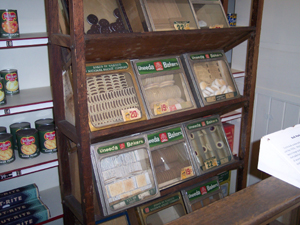 Cookie tins, WW II era store
so a visit to Strawbery Banke is a trip through time. The1762 home of Stephen Chase,
an early 19th century merchant, contains beautifully veneered and lacquered cabinetry
made for Chase by local craftsmen. Other homes show the details of 17th century
construction, explain the archaeological excavations (the good old stuff is three
to five feet deep), show the life of the Shapiros, Russian Jewish immigrants who
lived in Puddle Dock in the early 20th century, and exhibit a house and store dating
from the 1950's (it's awful to think of oneself as an antique, we decided, as we viewed
the meals on TV trays, and the paint-by-number picture on the mantel).
Cookie tins, WW II era store
so a visit to Strawbery Banke is a trip through time. The1762 home of Stephen Chase,
an early 19th century merchant, contains beautifully veneered and lacquered cabinetry
made for Chase by local craftsmen. Other homes show the details of 17th century
construction, explain the archaeological excavations (the good old stuff is three
to five feet deep), show the life of the Shapiros, Russian Jewish immigrants who
lived in Puddle Dock in the early 20th century, and exhibit a house and store dating
from the 1950's (it's awful to think of oneself as an antique, we decided, as we viewed
the meals on TV trays, and the paint-by-number picture on the mantel).
There was a fine exhibit of World War II memorabilia, a pottery and a cooperage,
where we discussed with the man making cask hoops with a drawknife why the craftsman at
Storrowtown had been so insistent that early Windsor chair legs were carved, not turned
 Swan
(lathes, he told us, had been around since the 1300s, and were easily fashioned by hand).
The community of craftspeople is special: he had apprenticed at Sturbridge Village, and
the barrels he was making will be shipped to the Jamestown Plantation.
Swan
(lathes, he told us, had been around since the 1300s, and were easily fashioned by hand).
The community of craftspeople is special: he had apprenticed at Sturbridge Village, and
the barrels he was making will be shipped to the Jamestown Plantation.
Our favorite visit was to the kitchen of an 18th century home, where we learned about coffeeberries and quinces, salads and baking (imported white flour and sugar was a sign of refinement and elegance.) This stop followed a hearty chowder and sandwich luncheon at the Dunaway Tavern, which looks to be also a serious dinner house, adjoining the museum.
Even the trip from Merrimack, where we are staying, was delightful. We spotted a large hawk standing by the roadside, and later a pair of swans. On the return trip we drove along the New Hampshire coast, lined with mansions, hotels, and small efficiency cottages, facing out to the Isles of Shoals, where one of our many seventeenth-century ancestors had dwelt.