Sister Laura landed at Logan Airport to join us for a whirlwind
Thanksgiving weekend. As young students and faculty, forty-some
years ago, we hadn't really learned much about Eastern Massachusetts.
We started out on a chilly Friday morning to walk part of
Boston's Freedom Trail which is marked by a line of red bricks in
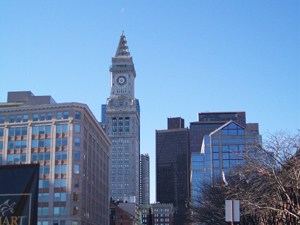 Boston skyline
the pavement. Talented and knowledgeable National Park Rangers gave
talks at the more important stops, such as Faneuil Hall and the Old
North Church. Longfellow's poem "The Midnight Ride of
Paul Revere" was exposed as mostly myth. We hadn't known Revere was
one of 50 riders spreading the alarm, nor that the real hero of the
night was Robert Newman, who actually set the light in the steeple
with redcoats in the neighborhood, nor that one rider was a 14-year-old
girl who substituted for her sick father.
Boston skyline
the pavement. Talented and knowledgeable National Park Rangers gave
talks at the more important stops, such as Faneuil Hall and the Old
North Church. Longfellow's poem "The Midnight Ride of
Paul Revere" was exposed as mostly myth. We hadn't known Revere was
one of 50 riders spreading the alarm, nor that the real hero of the
night was Robert Newman, who actually set the light in the steeple
with redcoats in the neighborhood, nor that one rider was a 14-year-old
girl who substituted for her sick father.
Across the street from the Freedom Trail -- which is marked
by a line of red bricks in the pavement -- is the moving Holocaust
Memorial, a line of tall glass towers on which are etched millions
of identification numbers of concentration camp inmates. Quotations
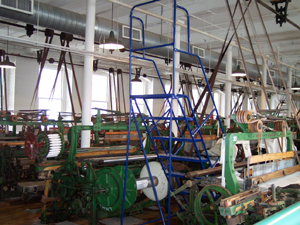 Bootts Mills looms
from survivors are inscribed on marble inside each tower.
Bootts Mills looms
from survivors are inscribed on marble inside each tower.
Our walk took us past Irish pubs (quite a few, not
surprisingly), a mix of Boston churches, skyscrapers and
historic buildings, Italian restaurants, yuppie shopping malls,
a bustling farmer's market, and the revitalized waterfront, full
of daylight as a result of the dismantling of the ugly overhead
freeway, courtesy of the Big Dig. Near the park, gilded pieces of
trash embedded in the pavement turned out to be civic art --
which never ceases to surprise!
There was snow on the ground in Lowell, Massachusetts,
where the American textile industry got its start early in the
19th century. Along the broad, swift Merrimack river, some of
the mill buildings have been transformed into condos, while
 Lowell boarding house
others are part of the National Park, placed through the influence
of Paul Tsongas, a native of Lowell.
Lowell boarding house
others are part of the National Park, placed through the influence
of Paul Tsongas, a native of Lowell.
The entry into the Bootts Mill museum is a shock. Dozens of
looms are set up and threaded; even with just a few running, the
noise is deafening. It made the floor vibrate and our ear-drums
ache. The mill occupied four huge floors, and the workers trudged
up a steep narrow staircase to get to position for their thirteen-hour
work day.
After the view of the working mill, an outstanding exhibit
tells the story of the industry and its changing work force. New
England farm girls -- who were part of what some mistakenly believed
would be an industrial utopia -- were soon replaced by European
immigrants, and the area became a hotbed of labor troubles, as
the mill owners struggled to compete with newer factories by
squeezing the workforce. The high point in mill production
was perhaps 1850, and the 150-year-long decline of the mills
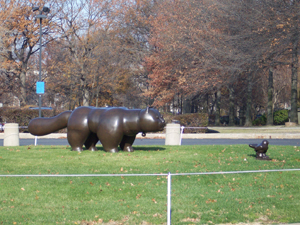 Museum of Fine Arts cat
tells the history of the slowly declining local economy, never quite
dying, but never revitalized. One side benefit for Lowell has
been a steady stream of upwardly-mobile immigrant families mixing
together in a hodgepodge of cultures, each seeking their own
vision of the American dream.
Museum of Fine Arts cat
tells the history of the slowly declining local economy, never quite
dying, but never revitalized. One side benefit for Lowell has
been a steady stream of upwardly-mobile immigrant families mixing
together in a hodgepodge of cultures, each seeking their own
vision of the American dream.
A treat for visitors is the trolley service, run partly
by the National Park Service and partly by a group of volunteers.
We rode twice, first in a restored Lowell street car with wicker
seats, its current supplied by its connection to overhead wires,
and second in a New Orleans streetcar (naturally it's marked for
the Desire Street route!)
Sunday we joined cousin Marilyn to visit the Isabella Stewart
Gardner Museum, but we were an hour early, so we first made a short
visit to the Musem of Fine Arts across the street -- a kind of Art
Appetizer!
The Isabella Stewart Gardner Museum had been one of our favorite
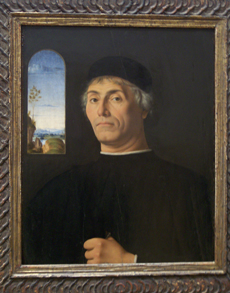 One of Boston's art treasures
places back in the 1960s and so we were eager to see it once again.
Housed in a building constructed about 1900 under Mrs. Gardner's
direction are the artworks she and her husband had collected during
years of foreign travel. A woman of strong opinions, she crowded
paintings, sculpture, porcelain, icons, autographs, rare books,
and architectural features into an enormous four-story building
with a huge skylight providing a temperate climate for the central
garden courtyard.
One of Boston's art treasures
places back in the 1960s and so we were eager to see it once again.
Housed in a building constructed about 1900 under Mrs. Gardner's
direction are the artworks she and her husband had collected during
years of foreign travel. A woman of strong opinions, she crowded
paintings, sculpture, porcelain, icons, autographs, rare books,
and architectural features into an enormous four-story building
with a huge skylight providing a temperate climate for the central
garden courtyard.
Here's the kicker: if the museum trustees move any of the
works of art from the positions they occupied at the time of her
death, the entire collection would be sold and the proceeds given
to Harvard University!
As a result, the Gardner Museum is old, worn, getting darker
and drearier -- and clearly failing to live up to its promise to bring
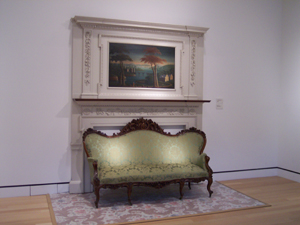 Peabody Essex Museum scene
great art to the public eye. As if to add insult to injury, the empty
frames where evil art thieves slit the canvas to remove 13 masterpieces
in 1990 -- to sit in the homes of even more evil art collectors -- remain
starkly on the walls. If you knew their whereabouts, you'd hardly be
tempted by the $5M FBI reward
Peabody Essex Museum scene
great art to the public eye. As if to add insult to injury, the empty
frames where evil art thieves slit the canvas to remove 13 masterpieces
in 1990 -- to sit in the homes of even more evil art collectors -- remain
starkly on the walls. If you knew their whereabouts, you'd hardly be
tempted by the $5M FBI reward
And why hasn't Harvard shown a little generosity? Do they
really need the proceeds of the sale of the Gardner's treasures so
badly? Do they really want to hurt their city by breaking up a
magnificent art collection for the sake of their already bulging
endowment? Surely the two beneficiaries of the Gardner Will --
Harvard and the Museum Trustees -- could reach a compromise that
would provide the public (remember them?) with a better opportunity
to view the Gardner collection, in keeping with the best of modern
museum practices.
In marked contrast to the Boston museums is the newly remodeled
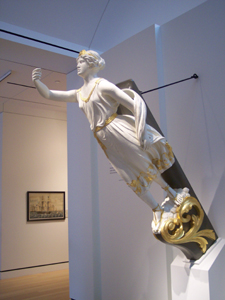 Figurehead
Peabody Essex Museum (PEM) in Salem. Five years ago we visited the
PEM and found it a quaint old warehouse stuffed with the treasures
acquired by nineteenth-century Salem merchantmen, along with models
and paintings of the ships and their milieu.
Figurehead
Peabody Essex Museum (PEM) in Salem. Five years ago we visited the
PEM and found it a quaint old warehouse stuffed with the treasures
acquired by nineteenth-century Salem merchantmen, along with models
and paintings of the ships and their milieu.
While we were elsewhere ... the PEM found a big pot of money,
built an enormous new museum, and spread the exhibits about in dozens
of thematic galleries. We had to disregard our warm memories of the
old museum and open our eyes to appreciate the new one.
What we gained most was an appreciation for Chinese culture,
old and new. The old was represented by the galleries full of Chinese
objets d'art made for the export trade -- because China was so poor
it scarcely had an internal market for art. The new was represented
by Yin Yu Tang, a lovingly reconstructed home of the extended Huang
family, who occupied it for eight generations -- until 1982.
This was the home of a "prosperous" merchant family for two
hundred years, and it showed that China -- even in 1982 -- was so
poor that the people lived without the benefit of machinery, making
tools and furniture out of materials at hand. Yet through the
 Saling ship, Salem harbor
poverty shone the light of Chinese art and culture, with its
strong emphasis on family and on tradition.
Saling ship, Salem harbor
poverty shone the light of Chinese art and culture, with its
strong emphasis on family and on tradition.
And best of all was an absolutely gripping video of a
modern Chinese marriage -- still arranged by the families, still
governed by traditional feasts and firecrackers and wedding night
rituals, and still representing the forced dislocation of a young
Chinese woman from the home of her parents to that of her in-laws,
where her role in the hierarchy will be totally changed.
Before rushing back to the airport we had time to walk through
Salem's historic district, past several attractions based on the
Salem witch hunts, and past Hawthorne's House of Seven Gables.
Visiting more than ten tourist attractions in four days was
a little breathtaking, but it provided us with a welcome break from
weeks of typing and proofreading genealogy -- not to mention a glorious
opportunity to spend time with Laura.