Johnstown, Pennsylvania is tucked into a narrow valley in the Allegheny
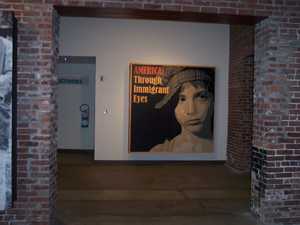 America: Through Immigrant Eyes
mountains, in what is known locally as the Laurel Highlands. The city is
not a highland at all; its business center lies along the Stonycreek and
Conemaugh Rivers, with houses climbing the steep hillsides. There have
been many disastrous floods here, the latest in 1977.
America: Through Immigrant Eyes
mountains, in what is known locally as the Laurel Highlands. The city is
not a highland at all; its business center lies along the Stonycreek and
Conemaugh Rivers, with houses climbing the steep hillsides. There have
been many disastrous floods here, the latest in 1977.
While the story of the floods would probably be sufficient reason
to visit Johnstown, we chose to visit the Heritage Discovery Center in
downtown Johnstown, which tells the story of the European immigrants who
came to work in the Pennsylvania coal mines and steel mills.
Each visitor selects a card depicting one of eight Johnstown
immigrants. When the visitor slides the card into certain exhibits,
the responses are tailored to the personality of that immigrant. For
 Ellis Island scene
example, an animated immigration officer at Ellis Island greets each
of the eight somewhat differently.
Ellis Island scene
example, an animated immigration officer at Ellis Island greets each
of the eight somewhat differently.
But the harsh stories are really quite similar. The Johnstown
immigrants, representing Italian, Polish, Jewish, Czech, and Slovak
ethnicities, were imported low wage workers who were held back at each
juncture, forced into unsanitary Johnstown ghettos, and exploited by the
bosses of the coal mines or the Crown Steel mills, which were for a
short time the largest steel mills in the U.S.
The museum depicts the way of life of the immigrants, who formed
communal societies based on their ethnicity and religion, worked hard
and saved money, part of which they sent back to "the old country" to
help their even more indigent relatives. Each of their efforts to
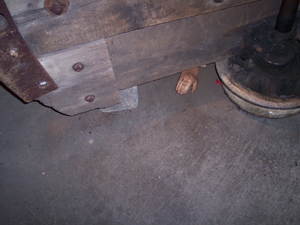 Hand of crushed worker
unionize was beaten back, and as other, more modern industrial centers
were built, Johnstown itself became less and less prosperous. After
World War II, the European workers were partly displaced by low cost
black workers imported from the American South. Today Johnstown looks
to tourism to supplement its weakening economy.
Hand of crushed worker
unionize was beaten back, and as other, more modern industrial centers
were built, Johnstown itself became less and less prosperous. After
World War II, the European workers were partly displaced by low cost
black workers imported from the American South. Today Johnstown looks
to tourism to supplement its weakening economy.
While we admit we intentionally visited Danville to learn more
about our Slovak heritage, we did not realize that Johnstown would
also be a magnet for poor Slovaks forced off their farms and oppressed
by the nineteenth century Magyarization projects in the Austro-Hungarian
empire. In fact we now know that the boom days of American immigration
-- 1890 through 1918 -- drew heavily on emigrants from Central and
Eastern Europe. The jobs they all took were in heavy industry in
the belt of industrial cities that stretched across the Northeast
and Great Lakes regions of the U.S.
The museum displays make extensive use of multimedia displays
and video projections. The simulation of the Bessemer steel process
reminded us of Disneyland, with the pulsating light and vapors of
"smoke" swirling around. Telephone receivers provided audio presentations
to supplement the well-designed visuals. The effect was to catch up
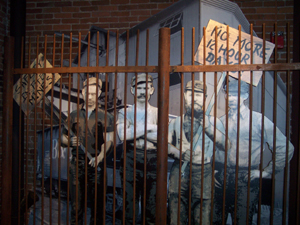 Some immigrants organized strikes
the visitor in the lives and emotions of the individual immigrants as
they struggled to succeed and eventually, through the generations,
become the English-speaking citizens of Johnstown.
Some immigrants organized strikes
the visitor in the lives and emotions of the individual immigrants as
they struggled to succeed and eventually, through the generations,
become the English-speaking citizens of Johnstown.
We were, of course, reminded of the museum at the Lowell textile
mills, where immigrants from the same countries settled around the
same time. Their descendants became the English-speaking citizens
of Lowell. The theme of both museums was to celebrate America as
a melting pot of foreign cultures and ethnicities.
At the very end of the tour of the Johnstown Museum, we were
asked to respond to a questionnaire: do we feel the U.S. should
have more immigrants? The responses were about 72% yes, which
was the way we voted, and frankly, we were surprised at the large
percentage who voted no. How selfish and ignorant to close the
door that was opened for our ancestors! More to the point, the
idea that we can somehow achieve prosperity by building a wall
 The Johnstown Inclined Plane
around our country shows no understanding of global economics;
and the idea that we can maintain our world reputation as a bastion
of freedom by closing our doors to foreigners shows no appreciation
of international politics.
The Johnstown Inclined Plane
around our country shows no understanding of global economics;
and the idea that we can maintain our world reputation as a bastion
of freedom by closing our doors to foreigners shows no appreciation
of international politics.
One more little Johnstown surprise awaited us after we left
the museum: The Johnstown Inclined Plane advertises itself as the
*world's steepest vehicular inclined plane*, a phrase which conveys
the spirit of 1891, when it was built, after the Flood of 1889 to
carry people living at the top of the hill downtown to work. Now
it is a tourist attraction (more attractive in the summer, we are
sure, than on a snowy December day) and most impressive.
We feel blessed with our curiosity to study the history of
the places we visit, and the time to indulge that curiosity.