Southern Ohio is coal mining. On this December day, our twisting snow-covered
road gave us many beautiful views of farmhouses and barns which
look as though they had been placed at random on the tops and sides of the
steep hills. In fact, the buildings are often small stock farms (complete
 Glass museum cabinets
with cold-looking cattle) or the homes of miners (we suppose), of which there
are many. This is strip-mine territory, where a wall of earth appears between
two hillsides and then just around a bend the mine equipment becomes visible,
with chutes carrying the coal up and down and dropping it into trucks or
trains. Among the mine sites, apple orchards spread on both sides of the
road, with signs for farm stands and Cider In Season; this is part of Johnny
Appleseed's route in the 1830s and perhaps part of his legacy as well.
Glass museum cabinets
with cold-looking cattle) or the homes of miners (we suppose), of which there
are many. This is strip-mine territory, where a wall of earth appears between
two hillsides and then just around a bend the mine equipment becomes visible,
with chutes carrying the coal up and down and dropping it into trucks or
trains. Among the mine sites, apple orchards spread on both sides of the
road, with signs for farm stands and Cider In Season; this is part of Johnny
Appleseed's route in the 1830s and perhaps part of his legacy as well.
At lunch in Beallville we saw dozens of hot lunches packaged and
carried out to the miners on the job; the walls of the restaurant were
covered with photos of the old train, discontinued in 1931, which used to
travel 115 miles in 9 hours, with up to 80 stops and whistle stops along the way!
Caldwell, Ohio (population 1,956) has a couple of motels, a
couple of gas stations and an old-fashioned town square lined with
19th-century buildings. After driving through tiny towns without any
stores at all, Caldwell looked like a big city!
The Baker Family Museum, known to Noble County as The Baker Glass
Museum, houses the accumulated treasures of a lifetime of collecting. The
museum owner, only daughter of a mine operator, began with objects from her
own family and added to her collection by attending local auctions and estate
 Wheeling girls
sales in her spare time. She worked at Wright Patterson Air Force Base until
her retirement; she is now 93 and still active. She specialized in the
products of local area glass and china producers, such as Cambridge,
Heisey, Fenton, Westmorland and Degenhart. When her family barn became
too full, her nephew built an earthquake-proof building to hold the museum,
together with rental apartments on the upper floors. The locals describe
the building with some disapproval as "California Style." It is flat-roofed with
pastel stucco walls, with a band of frosted glass windows. Display cases fill
the large exhibit area, revealing shelves full of toothpick holders, candy
dishes, place settings, vases, lamps -- just about everything. Although
glass and chinaware predominate, there were a goodly number of Jim Beam
Whiskey collector bottles lining the tops of the cabinets all around the room.
We were escorted through the museum by Sharon, a lively and enthusiastic woman
who formerly worked at the Baker's mine and who joined the museum just in time
to unpack and clean the objects after the move. She told us the whiskey bottles
were still full.
Wheeling girls
sales in her spare time. She worked at Wright Patterson Air Force Base until
her retirement; she is now 93 and still active. She specialized in the
products of local area glass and china producers, such as Cambridge,
Heisey, Fenton, Westmorland and Degenhart. When her family barn became
too full, her nephew built an earthquake-proof building to hold the museum,
together with rental apartments on the upper floors. The locals describe
the building with some disapproval as "California Style." It is flat-roofed with
pastel stucco walls, with a band of frosted glass windows. Display cases fill
the large exhibit area, revealing shelves full of toothpick holders, candy
dishes, place settings, vases, lamps -- just about everything. Although
glass and chinaware predominate, there were a goodly number of Jim Beam
Whiskey collector bottles lining the tops of the cabinets all around the room.
We were escorted through the museum by Sharon, a lively and enthusiastic woman
who formerly worked at the Baker's mine and who joined the museum just in time
to unpack and clean the objects after the move. She told us the whiskey bottles
were still full.
Sharon pointed out some of her favorites and we quickly found we had
favorites of our own. We enjoyed the irridescent colors of the carnival glass,
and the intricately hand-painted platters of RS Prussia -- another specialty of
Miss Baker. Most startling and lovely were the plates and vases painted with
portraits of the prostitutes of Wheeling, West Virginia. As Sharon put it,
"my brothers used to talk about Going to Wheeling to Get That Feeling!" By
this time Sharon's dog had determined it was time for lunch, so we thanked her
for the tour and collected our free pencils.
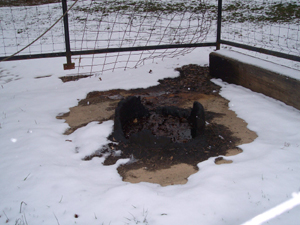 Early oil well
We followed Sharon's recommendation for lunch, traveling four towns
(about 3 miles) out of Caldwell to the Agabella Restaurant, where the special
was Chipped Beef on Biscuits and Harvard Beets.
On our way back to town we stopped at the monument (erected by Citizens
of Noble County and the Monument Builders of Ohio) to commemorate the death of
Ohio's last surviving soldier of the American Revolution, John Gray, who died
March 29 1868 at the age of 104 years, 2 months and 23 days.
Our last stop was marked by Caboose 33, from the narrow gauge Bellaire,
Zanesville and Cincinnati railroad -- or, as Sharon said, "Bent, Zigzag and
Crooked". The little shack next to the caboose was a flag stand: when the
red flag was hung out the door, the train stopped to pick up passengers or freight.
Today the caboose stands near the first oil well in this country.
According to the historical marker, "Salt was an important commodity to
early settlers because of its use in daily living. Silas Thorla and Robert
 Big Muskie bucket
McKee dug a well in search of salt brine. They discovered salt and, by
accident, discovered oil. Oil's value was unknown to them so they had to
separate the oil from the salt water by soaking the oil up from the surface
with blankets. The oil was wrung from the blankets, bottled as "Seneca Oil",
and sold as a "cure all." the remaining brine was boiled down to extract the
salt. Oil and gas caused many problems for Thorla and McKee. Sometimes
pressure built up and shot salt water forty feet into the air, or oil would
take the place of salt water in the well. Frustrated, they drilled a second
well in 1816, not far from the first. This well was cased with a large hollow
sycamore tree and is preserved on this site. A large salt works was set up
and salt was manufactured around the clock. The well also produced one barrel
of oil a week. the operation conitnued until an 1831 fire destroyed the works."
Big Muskie bucket
McKee dug a well in search of salt brine. They discovered salt and, by
accident, discovered oil. Oil's value was unknown to them so they had to
separate the oil from the salt water by soaking the oil up from the surface
with blankets. The oil was wrung from the blankets, bottled as "Seneca Oil",
and sold as a "cure all." the remaining brine was boiled down to extract the
salt. Oil and gas caused many problems for Thorla and McKee. Sometimes
pressure built up and shot salt water forty feet into the air, or oil would
take the place of salt water in the well. Frustrated, they drilled a second
well in 1816, not far from the first. This well was cased with a large hollow
sycamore tree and is preserved on this site. A large salt works was set up
and salt was manufactured around the clock. The well also produced one barrel
of oil a week. the operation conitnued until an 1831 fire destroyed the works."
Sure enough, as we gazed at the remains of the well, we could see the
occasional bubble of gas in the oily water.
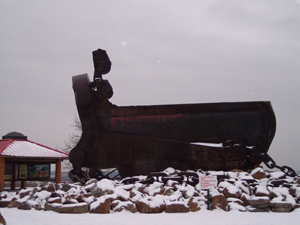
On the road west of Caldwell is The Big Muskie Bucket -- a legacy of the
strip mining industry which dominated southeastern Ohio from the 1940s to the
1980s. It weighs 460,000 pounds empty and could carry an additional 640,000
pounds, in volume equal to that of a 12 car garage. Now that new technologies
and the diminishing supply of Ohio coal have ended the heyday of mining, this
giant bucket sits rusting in its Miners' Memorial Park, part of ReCreation
Lands, a project for replanting formerly stripped areas. Hiking trails and
 Tobacco drying in barn
campsites abound.
Tobacco drying in barn
campsites abound.
As we approached the Ohio River the signs of poverty grew more severe;
whole towns were mostly boarded up, many houses were abandoned or worse,
still lived in but in terrible disrepair. Since we travel around so freely,
we find it difficult to understand those who stay put, jobless and without hope.
But we do know that for some people leaving home is so frightening that they
can't bring themselves to go, even when their town is clearly dying.
Which is not to say that those who remain complain. On the contrary,
they are friendly and warm, matter-of-fact, conservative and patriotic.
At one restaurant and two homes the Blue Star flag was flown -- begun in
WW II, now indicating a son (or daughter) serving overseas.