 Decatur, Texas courthouse
country, where the towns, even the county seats, are small and getting smaller.
Decatur, Texas courthouse
country, where the towns, even the county seats, are small and getting smaller.
As we continue to crisscross Texas, the challenge of finding new and different
roads becomes greater. This year's trip found us deep in oil and cotton and cattle
Decatur, Texas courthouse
country, where the towns, even the county seats, are small and getting smaller.
*Eighter from* Decatur, Texas has one of the prettiest county courthouses in the state. A parade of photos of county judges occupies all available wall space along the corridors. On the other hand, Chico, Texas, is dusty and almost deserted. One large old building (hotel? hospital?) now stands forlorn, doors open and windows cracked, but curtains on one wing suggest that some squatters live there.
Snyder, Texas, is typical of American towns around which bypasses have
been built. The businesses along the old road through the center of town have
closed up and relocated near the bypasses, leaving the old buildings to decay
and rot and become nests of poverty and perhaps crime, not to mention unloveliness.
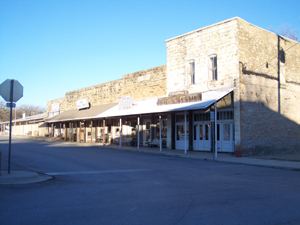 Downtown Chico, Texas
When will America learn to declare its shattered buildings public nuisances?
Perhaps when their owners get off the city councils?
Downtown Chico, Texas
When will America learn to declare its shattered buildings public nuisances?
Perhaps when their owners get off the city councils?
Northwest Texas grows cotton. We passed field after field, where fluffy white traces along the edge of the road showed where cotton had spilled from the trucks heading to the gin, and great piles of cotton remained where wind had blown against the stacked crop as it waited to be trucked away. We couldn't figure out why some cotton was still unharvested in the fields, but learned the answer at the B Bar C cafe in Hamlin: 2005 yielded the biggest cotton crop since the 1950s, and has overwhelmed the capacity of the gins. The man in the cafe explained that some growers had neglected to spray for insects, and their yield was much less. They are hoping to get the harvesting completed by the end of February. We wondered whether Texans who own fields of cotton still call themselves ranchers. Incidentally, the B Bar C has an excellent but fattening buffet lunch.
If a ghost town is one that is completely unoccupied, then we might use the
term ghostly town for one that seems to be heading for oblivion. Patricia, with
 Cotton and oil near Hamlin
its thriving cotton gin, and Orla, with some lots for storing and maintaining heavy
equipment, and a quaint but probably dead *general store*, qualify as ghostly.
Cotton and oil near Hamlin
its thriving cotton gin, and Orla, with some lots for storing and maintaining heavy
equipment, and a quaint but probably dead *general store*, qualify as ghostly.
The back roads of Texas are fast and safe, travelled mostly by those with
local business to do, but the interstates do have the preponderance of gas stations.
Needless to say, there was no gas in Patricia nor Orla, and since we took the back
road past the Guadelupe Mountains -- a national park with no gas station -- we found
ourselves 100 miles from El Paso with less than a quarter tank. So we began arguing
whether a full tank would take us 500 miles still (it would have when the truck
was new) and how reliable was the fuel gauge, until we saw a sign painted on cardboard
promising gas 7 miles ahead. Then we began arguing about the validity of the sign,
but of course in seven miles, one of us won the argument, and we talked to a man who
had moved down from Roswell, N.M. and bought the one-pump no-name station in another
ghostly town whose name we never learned. He went inside and turned on the tank and
 May's Cafe, Cornudas, Texas
we gave it a sawbuck's worth, not worrying where or how he managed to come by that
fuel. Cash only, about four bits a gallon higher than El Paso!
May's Cafe, Cornudas, Texas
we gave it a sawbuck's worth, not worrying where or how he managed to come by that
fuel. Cash only, about four bits a gallon higher than El Paso!
Still another ghostly town is Cornudas whose mayor, May, has a signed photograph of George and Laura on the wall of her cafe, which is all there is of the town. When we saw the semis and government trucks parked outside we knew we had found lunch. Ranch-style burgers and wonderful chicken-fried steaks were served by a waiter with a grey and white handlebar moustache. To another table came a salad bowl as big as a bowling ball. When we weren't eating we looked at the walls and tables papered with foreign currency and cards and letters from around the world.