El Paso sits across the border from the fourth largest city of Mexico, has benefited
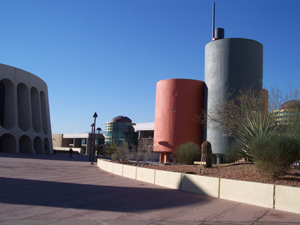 The El Paso Visitor Center
greatly from NAFTA and nearby Fort Bliss, and culturally belongs to New Mexico rather than
Texas. We often stay on the west side, on the road to the Sunland Race Track and Casino,
and close to several large shopping malls and UTEP (University of Texas at El Paso).
The El Paso Visitor Center
greatly from NAFTA and nearby Fort Bliss, and culturally belongs to New Mexico rather than
Texas. We often stay on the west side, on the road to the Sunland Race Track and Casino,
and close to several large shopping malls and UTEP (University of Texas at El Paso).
A majority of the citizens are of Hispanic ancestry, and there are a variety of
Mexican restaurants to choose from. Today's recommendation, oddly enough, is for a chain --
El Taco Tote -- which features a variety of soft tacos, including specialty tacos like barbacoa
(goat or beef head) and puerco adabado (slowly stewed and spiced pork). The best feature is their
bright salsa and relish bar, with lettuce, cucumber, radish, cilantro, and six or seven really good
salsas. If you're not into dripping soft tacos, you can have various skillets of fajitas or brocheta,
still served with tortillas and mix your own salsa. It's tremendously popular, and there's just as
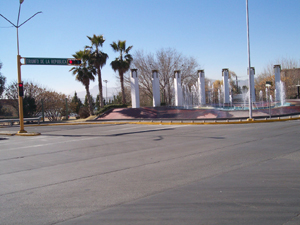 Ciudad Juarez fountain
much take-out business as eat in at lunchtime.
Ciudad Juarez fountain
much take-out business as eat in at lunchtime.
This trip we saw a little more of El Paso. The Art Museum, located in the civic center area
near a Science Museum and auditorium, is a sign of El Paso's ambitions for culture. It's a good small
museum. The visitor is greeted by a gallery of some twenty modern pieces of sculpture, mostly by
Southwestern artists. There is a gallery of murals by 50's western writer and artist Tom Lea, which
have been restored and relocated from their original walls in homes or old stores. A room of portraits
and some religious art from west Texas and New Mexico, and the S. Kress Collection of European art round
out the museum.
Across the street we caught the trolley for a quick tour of Ciudad Juarez. The trolley
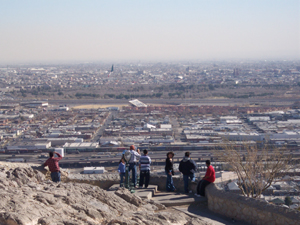 Overlooking both cities
was not crowded, and evidently everyone goes just to shop, for they all got off at the first group
of stores. We just took the ride through a typical border city, which is always a bit depressing,
as the standard of living is so much lower than in the U.S. To think more than three million
people live here!
Overlooking both cities
was not crowded, and evidently everyone goes just to shop, for they all got off at the first group
of stores. We just took the ride through a typical border city, which is always a bit depressing,
as the standard of living is so much lower than in the U.S. To think more than three million
people live here!
Back in El Paso, a north-south chain of mountains pushes almost to the Rio Grande,
making a challenge for the city to expand around its downtown core. But the engineers have
persevered, and built a series of daunting roads and driveways snaking up the mountainsides
to precariously perched hillside mansions, which sit in bare splendor atop sharp brown
desert rocks. Imagine a cadre of multimillionaires colonizing Mars, and you've got the picture.
Another engineering marvel is the loop road which winds through a former cattle
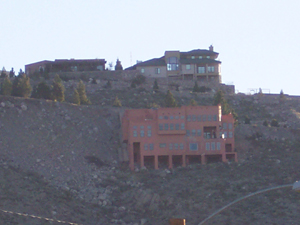 Cliff homes in El Paso
rustlers' pass and provides wonderful views. Unfortunately, even on this winter day, the
air above the Rio Grande valley was brown with smog: both nations do not have the same
emissions control standards.
Cliff homes in El Paso
rustlers' pass and provides wonderful views. Unfortunately, even on this winter day, the
air above the Rio Grande valley was brown with smog: both nations do not have the same
emissions control standards.
These mountains even boast an aerial tramway up a dizzingly steep hillside. Built
originally to carry steel to build a radio transmission tower, the tram was privately
operated for a while and now is run by the Texas State Parks. Just driving up the road
to the tram station is an experience!
But above all, El Paso is a thriving city -- a welcome relief after so many ghost
towns. We were first here in 1965, and the city has mushroomed since then. We're looking
forward to our next visit.