The story of the De Young Museum in Golden Gate Park is the story of a few remarkable
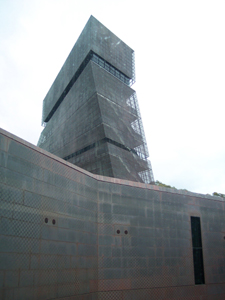 The new De Young Museum
people who have given an extraordinary gift to their city. In 1893, newspaper publisher
M. H. De Young led a drive for a new museum to house his collection of stuffed birds.
When he learned that the labor of seeking out museum pieces for sale was a large factor
in the price, he embarked on a lifelong mission of collecting for his museum -- everything
from sculptures, polished tree slabs, birds' eggs and, ultimately, his own collection
of knives and forks.
The new De Young Museum
people who have given an extraordinary gift to their city. In 1893, newspaper publisher
M. H. De Young led a drive for a new museum to house his collection of stuffed birds.
When he learned that the labor of seeking out museum pieces for sale was a large factor
in the price, he embarked on a lifelong mission of collecting for his museum -- everything
from sculptures, polished tree slabs, birds' eggs and, ultimately, his own collection
of knives and forks.
The museum was heavily damaged in the 1906 San Francisco earthquake but was
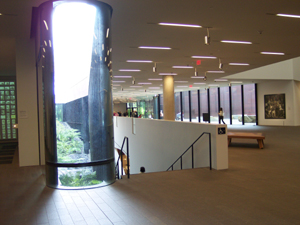 Curved glass reveals a garden
rebuilt and became even more successful.
Curved glass reveals a garden
rebuilt and became even more successful.
The original De Young Museum merged with the Museum of the Legion of Honor
in 1972 to become The Fine Arts Museums of San Francisco, with each museum having
its own collecting philosophy -- no more birds' eggs, but much more art, with the
De Young specializing in arts and crafts of the Americas, Africa and Oceania, while
the Museum of the Legion of Honor displays art from Europe and Asia.
Another remarkable donor, Harold Wagner left the De Young a legacy of some
unique murals from the Teotihuacuan empire; after lengthy negotiations, the museum
worked cooperatively with Mexican archaeologists and returned part of the collection
for display in Mexico. An entertaining article on this project can be found at:
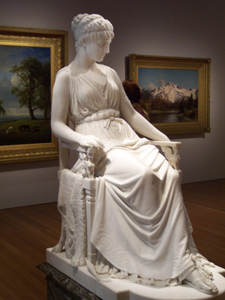 Gallery at the De Young
http://palimpsest.stanford.edu/waac/wn/wn08/wn08-3/wn08-301.html
Gallery at the De Young
http://palimpsest.stanford.edu/waac/wn/wn08/wn08-3/wn08-301.html
The De Young was again damaged in 1989 in the Loma Prieta earthquake. During
the following years, several bond issues supporting its reconstruction were narrowly
defeated. Doris Wilsey, another remarkable supporter, organized the bond campaigns,
and then led a private fund drive to rebuild the museum, kicked off with a ten million
dollar gift from the Wilsey family.
The landscaping around the new De Young Museum is still being completed, while
other older buildings in the park are being replaced. Since we parked in the underground
garage, we didn't get much of a look at the controversial copper-covered exterior, but
from the inside the architecture was lovely, with large gallery spaces arranged in
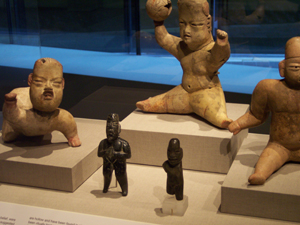 Olmec statues
several wings on two floors. Narrow interior windows allow visitors to look down from
the upper galleries, along the broad stair to the lower floor corridor, and many small
windows give peeks to the outdoors, where a varied landscape makes the most of San
Francisco's temperate climate. An outdoor fern garden appears to pass through the
building's interior, next to the staircases.
Olmec statues
several wings on two floors. Narrow interior windows allow visitors to look down from
the upper galleries, along the broad stair to the lower floor corridor, and many small
windows give peeks to the outdoors, where a varied landscape makes the most of San
Francisco's temperate climate. An outdoor fern garden appears to pass through the
building's interior, next to the staircases.
We were most taken by the outstanding display of ancient art from the Americas,
especially since we're in the middle of Charles Mann's book *1491,* which describes
the elaborate American civilizations that predated the European explorers. The
collection of more recent American art was also impressive, and the entire museum
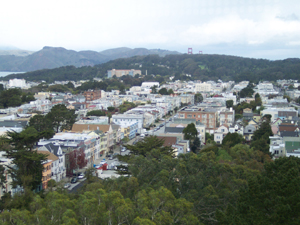 The view from the tower
was too rich to absorb in a single visit.
The view from the tower
was too rich to absorb in a single visit.
We rode the elevator to the observation deck of the tower and enjoyed
panoramic views of the city. Because of its hills, San Francisco presents a
striking variety of views depending on where you are standing, and the views
from the De Young tower were terrific, with the greenery of the park making a
lovely contrast with the houses and the distant buildings.
We're very grateful to San Francisco's philanthropists for keeping the
De Young Museum and Golden Gate Park a vibrant part of the cultural life of the city.