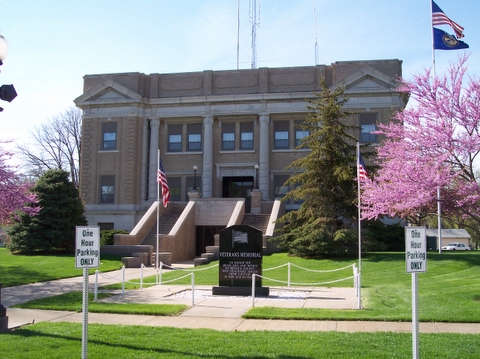
 At least we
located courthouses in each of the five remaining counties, but we
remain convinced that Texas does it better!
At least we
located courthouses in each of the five remaining counties, but we
remain convinced that Texas does it better!
In Texas, county courthouses have presence. In the smallest of counties, the county seat has a central square dominated by the court building, usually at least two stories tall, often with a tower and always surrounded by lawn. Parking places are reserved for judges, sheriffs, prosecutors and court clerks. In Nebraska, courthouses are much more modest.
We had a rather short drive to make from Grand Island to Omaha,
Nebraska, so we decided to hunt for courthouses. We zigzagged
up and down and across the eastern part of the state, making our first
stop at the birthplace of the famous baseball player, Grover Cleveland
Alexander, the "third winningest pitcher in major league baseball
history" according to the historical marker. He was portrayed
by actor Ronald Reagan in a 1952 movie. That was more
impressive than the courthouse, which was nice but which resembled a
small high school building. On our second try, in Nance
County, we drove around and around and around but never did find the
courthouse. We know there must have been one, because several
people are running for Clerk of the Court there. At least we
located courthouses in each of the five remaining counties, but we
remain convinced that Texas does it better!
We were again reminded of Texas as we approached our motel, because, just like San Antonio, Omaha is engaged in massive road-building efforts, with the new highway chewing up the traffic patterns. "Everybody is already mad when they get here," said the clerk at the motel.
We have just acquired from Slovakia in preparation for our trip, an oversize heavy book entitled Etnografitcky Atlas Slovenska, produced by the Slovak Academy of Sciences in 1990. This is an outstanding scholarly work on the customs and folkways of Slovaks over the centuries, by geographic area. It was written in Slovak, with Russian and German headings, as a last gasp of the Communist government. The Slovak Republic has printed an accompanying English translation, since (like Ireland) there are more people of Slovak descent in America than in Slovakia! So now we know that baskets constructed in the Danube River area were made of reeds, while those in the forested region were of tree roots. Even the shapes of farm tools were identified with their areas of use.
To our delight there was a Czech-Slovak Festival at Thirteenth and
Martha Streets in Omaha. It was a jim-dandy event, even for
people like us who didn't know any of the participants.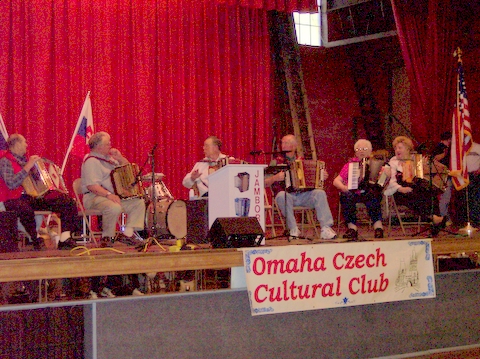 A
six-member accordion band entertained with polka music while guests
cued up for a home-cooked meal of either duck or pork, sauerkraut and
dumplings, slices of rye bread home-made by the Sisters of
Notre Dame, etc.
A
six-member accordion band entertained with polka music while guests
cued up for a home-cooked meal of either duck or pork, sauerkraut and
dumplings, slices of rye bread home-made by the Sisters of
Notre Dame, etc.
The festival was held in the Sokol, an institution of great
significance to the Czech and Slovak immigrant communities in the
United States. It has been the community center, sports and
fitness center, and office for local newsletters and
newspapers.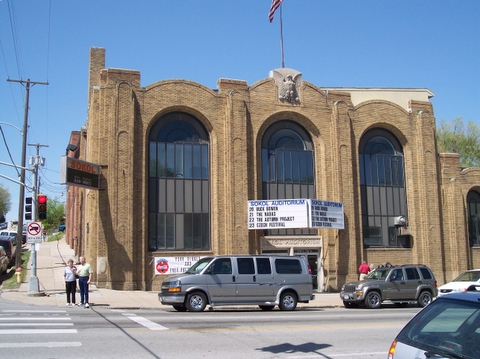 Several years ago we visited a Sokol for the
first time while tracing Bob's maternal grandparents, and we heard the
story of how his mother, as a teenager, won an award for climbing the
ropes to the high ceiling of the gym -- upside down! We were
especially pleased to see that these climbing ropes and ladders are
still in place in the gym where we ate.
Several years ago we visited a Sokol for the
first time while tracing Bob's maternal grandparents, and we heard the
story of how his mother, as a teenager, won an award for climbing the
ropes to the high ceiling of the gym -- upside down! We were
especially pleased to see that these climbing ropes and ladders are
still in place in the gym where we ate.
Many of the participants wore traditional Czech costumes, with bright
ribbons and beautifully embroidered blouses and shirts. We
enjoyed seeing women of all ages, including small children, all dressed
up.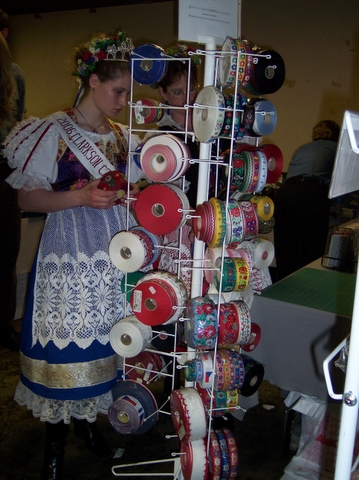
We learned about the art of dyeing Easter eggs, a traditional craft
throughout eastern European countries. The theory is that
originally only the nobility had richly dyed
costumes. The peasants had no textiles to speak of, but
everybody had a chicken or several, and decorated the shells for
Easter. Today, the dyes used are toxic and the eggs are
solely for decoration, and are exquisite.We watched
the
demonstrator press a small ball of beeswax into the "stucka", a
pen-like device.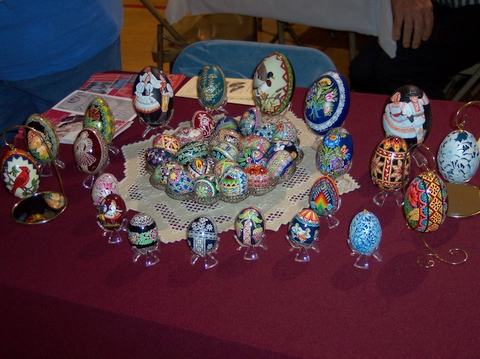 She heated the wax
over a small burner, then
drew delicate lines and dots on the white eggshell. The
application of many layers of dye of different colors produces an
intricate, multi-colored object -- she says each egg takes her about
six hours.
She heated the wax
over a small burner, then
drew delicate lines and dots on the white eggshell. The
application of many layers of dye of different colors produces an
intricate, multi-colored object -- she says each egg takes her about
six hours.
The great plains states tended to get more Czechs than Slovaks, and although this was billed as a Czech-Slovak festival, that name is probably a holdover from the days of Czechoslovakia, now past. We did see that the Czech and Slovak languages are quite closely related, however. We left happily, with full tummies, and burdened with a half-dozen extra kolachy (little round pastries topped with jam) and a large round loaf of rye bread. We're already watching the internet for more opportunities to enjoy Slovak-American culture!