We first saw the photo of Bob's great-aunt Katarina last May, when we met our second cousin
Marion. The photo, which none of us could identify at the time, showed a woman in Slovak dress
standing in a doorway with a very small boy at her side.
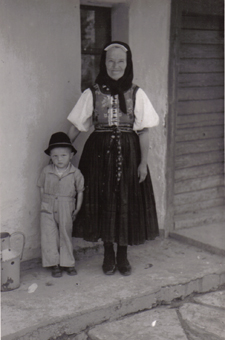 Unknown woman and boy
It had been in a box with other Hopko
photos, so we thought it might be a Slovak relative. The story ended exultantly two weeks ago
when our newly-discovered second cousin Berty jabbed a finger at the picture and exclaimed in
Slovak that it was a long-lost photo of his grandmother and his brother Janko now living in Chicago!
Unknown woman and boy
It had been in a box with other Hopko
photos, so we thought it might be a Slovak relative. The story ended exultantly two weeks ago
when our newly-discovered second cousin Berty jabbed a finger at the picture and exclaimed in
Slovak that it was a long-lost photo of his grandmother and his brother Janko now living in Chicago!
From the Slovak church records we examined in Salt Lake City before our trip we had learned that
our Slovak great grandparents Janos Hopko and his wife Maria Bodnar
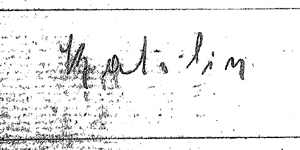 Parish register entry
had six surviving children,
named Janos, Istvan, Maria, Andras, Anna, and "Katilin." The last name was very peculiar, but
that's the way it appeared on the parish register (see photo.) We knew that the first five had
emigrated to the U.S., but we didn't know what had happened to "Katilin."
Parish register entry
had six surviving children,
named Janos, Istvan, Maria, Andras, Anna, and "Katilin." The last name was very peculiar, but
that's the way it appeared on the parish register (see photo.) We knew that the first five had
emigrated to the U.S., but we didn't know what had happened to "Katilin."
Some of the Hopkos had emigrated to New Jersey, others to Minnesota. We travelled to Minnesota,
met second cousins there, and discovered the 1979 obituary of our great aunt Anna (Hopko) Vargo,
who was survived by "4 children, 9 grandchildren, 18 great-grandchildren, and 1 sister in Czech."
So we knew that "Katilin" was living in 1979.
As we planned our trip to Slovakia we realized that even though "Katilin" was born a Hopko, her
married name would be something different. Another difficulty was that there was no guarantee
whatsoever that "Katilin" had stayed in the village of her birth. She could be anywhere! And
of course it was just a wild guess that "Katilin" was the woman in the photo with the little boy.
Nevertheless, we went to the Gregorovce cemetery and began walking up and down the rows.
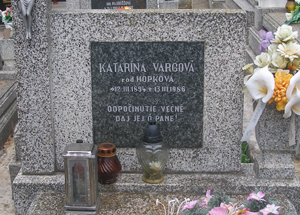 Katarina's grave
There were perhaps 200 graves, so it didn't take a long time. We were remarkably fortunate to find
Katarina's grave. Translated into English, the inscription says "Katarina, wife of Mr. Varga,
born in the family of Mr. Hopko, 12 Mar 1894, died 13 Mar 1986. Give her eternal rest, O Lord!"
The date was the proof, because our "Katilin" had been born 12 Mar 1894 and baptized 14 Mar 1894,
so we knew that her correct name was Katarina, and that she had married a Mr. Varga. We also knew
that her sister Anna had married a Mr. Stephen Varga (later changed to Vargo) in Minneapolis,
an arranged wedding. We suspected that this was no coincidence. On a yellow lined pad we wrote
in careful Slovak, "We are looking for the descendants of Katarina Vargova, rodina Hopkova."
Katarina's grave
There were perhaps 200 graves, so it didn't take a long time. We were remarkably fortunate to find
Katarina's grave. Translated into English, the inscription says "Katarina, wife of Mr. Varga,
born in the family of Mr. Hopko, 12 Mar 1894, died 13 Mar 1986. Give her eternal rest, O Lord!"
The date was the proof, because our "Katilin" had been born 12 Mar 1894 and baptized 14 Mar 1894,
so we knew that her correct name was Katarina, and that she had married a Mr. Varga. We also knew
that her sister Anna had married a Mr. Stephen Varga (later changed to Vargo) in Minneapolis,
an arranged wedding. We suspected that this was no coincidence. On a yellow lined pad we wrote
in careful Slovak, "We are looking for the descendants of Katarina Vargova, rodina Hopkova."
The next morning we drove back into Gregorovce as early as we thought would be socially acceptable,
and indeed the people of the village were just beginning to stir.
 On the way to Berty's
It is a marvelous thing, a
Slovak dedina -- a living, breathing entity of networked people, all of whom know everybody
else, all willing and eager to help one another, the village, and the infrequent visitors to
the village. We had been noticed as we visited and inspected the cemetery the day before.
When we arrived today a woman came out of what Tom thinks is the sexton's house, next to the
church. We approached her and showed her the question we had written. She read it, smiled,
nodded, talked to us with limited success in Slovak, and called out to someone, and remarkably,
it appeared that another person, a man, was standing in front of the little store, looking at
the community notice board in front. Our good fortune continued.
On the way to Berty's
It is a marvelous thing, a
Slovak dedina -- a living, breathing entity of networked people, all of whom know everybody
else, all willing and eager to help one another, the village, and the infrequent visitors to
the village. We had been noticed as we visited and inspected the cemetery the day before.
When we arrived today a woman came out of what Tom thinks is the sexton's house, next to the
church. We approached her and showed her the question we had written. She read it, smiled,
nodded, talked to us with limited success in Slovak, and called out to someone, and remarkably,
it appeared that another person, a man, was standing in front of the little store, looking at
the community notice board in front. Our good fortune continued.
Bob showed the pad to the man, who smiled, nodded, talked in Slovak, and gestured for Bob to
follow. Before the others knew what was happening Bob was heading down the street with the man,
around one corner and then another to a house, where in a little while a woman emerged. The man
talked to the woman, the woman nodded, smiled, talked in Slovak, and showed Bob in. We asked,
"Starosta?" but no, this was not the Mayor's house. The woman was Maria, the wife of Bob's
second cousin Bartolomiej, nicknamed Berty. Soon all four Americans had arrived at Berty
and Maria's house.
Just as in Sarisske Sokolovce, we had prepared a book for Gregorovce, showing all the American
descendants of Janos Hopko and his wife Maria Bodnar. With the words manzel and manzelka
 Berty and Maria
(husband and wife), brat and sestra (brother and sister), otec and matka (father and mother),
syn, dcera, and deti (son, daughter, and children), together with much pointing, we explained
the relationships. We were greatly aided by the multitude of pictures in the book, and Berty
recognized some of the pictures. Then he stared at the photo we had found, of the woman and the
child, and told us it was his stary matka (literally old mother) Katarina and his brother Janko.
Now we were absolutely certain of our success. We all began hugging and about this point the
cognac and coffee came out, served in beautiful gold cups.
Berty and Maria
(husband and wife), brat and sestra (brother and sister), otec and matka (father and mother),
syn, dcera, and deti (son, daughter, and children), together with much pointing, we explained
the relationships. We were greatly aided by the multitude of pictures in the book, and Berty
recognized some of the pictures. Then he stared at the photo we had found, of the woman and the
child, and told us it was his stary matka (literally old mother) Katarina and his brother Janko.
Now we were absolutely certain of our success. We all began hugging and about this point the
cognac and coffee came out, served in beautiful gold cups.
Berty also recognized the wedding pictures of his grandmother's American brothers and sisters,
and he explained that the sisters Anna and Katarina had indeed married brothers Stephen and
Andrej Varga. The story of Katarina and Andrej was poignant. After the birth of their two
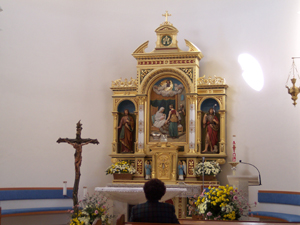 Inside the village church
daughters, Andrej had gone alone to America where his brother Stephen was working, but Katarina
had stayed in Gregorovce to care for her aging parents. When Katarina was ready to join Andrej
in America, it was too late -- World War II and the Soviet control of Czechoslovakia prevented
the two from ever rejoining one another. We learned that Andrej died in St. Moritz, Wisconsin,
and we plan to visit his grave.
Inside the village church
daughters, Andrej had gone alone to America where his brother Stephen was working, but Katarina
had stayed in Gregorovce to care for her aging parents. When Katarina was ready to join Andrej
in America, it was too late -- World War II and the Soviet control of Czechoslovakia prevented
the two from ever rejoining one another. We learned that Andrej died in St. Moritz, Wisconsin,
and we plan to visit his grave.
So another wild guess turned out correct. Many of the old pictures had been lost, so Berty was
delighted when we said the book was to be a present for him, and everybody in the family was
eager to see it.
We continued to reminisce and tell family stories through the afternoon, pausing for some
delicious local klobasa and cheese and fresh tomatoes and bread and wine for lunch. Recognizing
the language barrier, Berty thought of relatives who spoke English. There was his granddaughter
Natalie, who was just in her first year of English, but a better chance was his nephews, Janko's
children Marek, Slavomir, and Patrik, all university graduates who were quite familiar with English.
It turned out that Patrik was coming to Presov for the weekend and so we agreed to get together again
on Saturday.
 Old graves have no markers
Before we left we returned to the cemetery. We had searched in vain the day before for the
graves of Janos Hopko and his wife Maria Bodnar. Berty told us they had been buried with a
wooden cross, which had since gone, but he could show us from memory the location of the graves
of our common great-grandparents. We learned that it is the practice in Slovakia
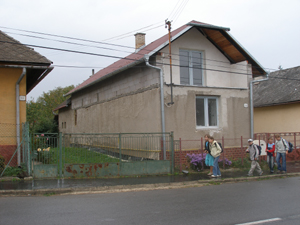 The old Hopko home
to work from
one side of the cemetery to the other, placing the new graves on top of the old.
The old Hopko home
to work from
one side of the cemetery to the other, placing the new graves on top of the old.
On the way to the cemetery Berty pointed out the old houses, close to the center of town, where
our great-grandparents the Hopkos and Bodnars had lived. Our grandparents were born in the Hopko home.
Returning on Saturday we met more of the family -- everyone whom Berty could get together on short
notice. Berty's sister Jan and his brother Jozef were also second cousins, and Janko's wife and son
 Big family reunion at Jozef's
Patrik were there, as were many younger relatives -- children and grandchildren. We took a lot of
photos, and visited Jozef at his new home in the neighboring village of Hubosovce.
All five children had received part of the land, and they had planted wonderful gardens full of
vegetables and flowers. Once again we enjoyed delicious home-made pastries, as we admired the
remodeling work Jozef is doing on his house.
Big family reunion at Jozef's
Patrik were there, as were many younger relatives -- children and grandchildren. We took a lot of
photos, and visited Jozef at his new home in the neighboring village of Hubosovce.
All five children had received part of the land, and they had planted wonderful gardens full of
vegetables and flowers. Once again we enjoyed delicious home-made pastries, as we admired the
remodeling work Jozef is doing on his house.
We left Gregorovce feeling that we were part of a large family just now becoming known to us.
We remembered that Katarina lived most of her live isolated from her husband and his American
relatives, but our young cousins have computers and cell phones and can reach across oceans.
If this technology had been available to Katarina and her family, no repressive government could have
succeeded in keeping her from reaching her husband.