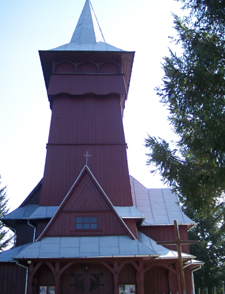
 The Roman Catholic church
could contact
any living relatives. In addition, we hoped to learn something about the connections between
Southeastern Poland and Northeastern Slovakia.
The Roman Catholic church
could contact
any living relatives. In addition, we hoped to learn something about the connections between
Southeastern Poland and Northeastern Slovakia.
Marilyn's grandfather had been born in Slovakia but moved to Poland, settling in the village of
Labowa near the border. Some of the family members emigrated to the United States; others remained
in Poland. We were interested in learning more about this family, and seeing if we
The Roman Catholic church
could contact
any living relatives. In addition, we hoped to learn something about the connections between
Southeastern Poland and Northeastern Slovakia.
The border crossing between Poland and Slovakia was unexpectedly formal, with all passports carefully examined and stamped each way. In addition, since our cars did not have Polish license plates, the car papers had to be examined as well when entering Poland. We were glad we had taken pains in advance with our rental car agencies to insure we could visit Poland.
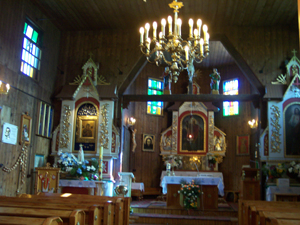 The Roman Catholic church
The road to Labowa passes through the interesting Polish city of Krynica with four-star resort hotels
and spas. Upon entering Labowa we looked for the church, as the cemetery is usually near by.
Finding the church on a dead end street, we pulled into the driveway of the house across the
street to turn around. Just then the priest drove home and wanted to pull into his driveway!
We got over our embarrassment, relocated the car, and started to talk to the priest.
The Roman Catholic church
The road to Labowa passes through the interesting Polish city of Krynica with four-star resort hotels
and spas. Upon entering Labowa we looked for the church, as the cemetery is usually near by.
Finding the church on a dead end street, we pulled into the driveway of the house across the
street to turn around. Just then the priest drove home and wanted to pull into his driveway!
We got over our embarrassment, relocated the car, and started to talk to the priest.
The priest spoke Polish and Russian and we spoke English and struggled with Slovak, so we weren't making too much progress until we realized we each had a little German! So we were able to see the Roman Catholic Church, which, he explained, was relatively new -- only 80 years old. The old church in town was the Greek Catholic Church, which had been standing for 340 years, but is no longer in use because it cannot be heated. (There was more to this story, as we learned later.)
We found the cemetery and walked around looking for graves, and sure enough found several graves which we recognized to be the locations of Marilyn's great-aunts and great-uncles. But we didn't find the graves of her great-grandparents. What to do?
It was lunchtime and a pleasant restaurant stood not far from the cemetery. We enjoyed soup
with kielbasy and hard-boiled eggs followed by potato pirogy (called "Russian ravioli" here)
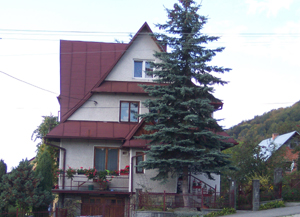 Maggie's parents' home
covered with salt pork and butter. We started talking to the waitress about studying family
history, and then Marilyn mentioned the last name of a second cousin she had met years
ago when on a tour to Poland. As soon as Marilyn said the name the waitress' eyes lit up.
Of course she knew Maggie! The waitress tried to give us directions to Maggie's house, but
then took off her apron and climbed in her car and led us down to the highway, past the road
construction, and up a tiny road that snaked up the hillside, where she pointed out Maggie's
house, under construction, and Maggie's parents' home, across the street!
Maggie's parents' home
covered with salt pork and butter. We started talking to the waitress about studying family
history, and then Marilyn mentioned the last name of a second cousin she had met years
ago when on a tour to Poland. As soon as Marilyn said the name the waitress' eyes lit up.
Of course she knew Maggie! The waitress tried to give us directions to Maggie's house, but
then took off her apron and climbed in her car and led us down to the highway, past the road
construction, and up a tiny road that snaked up the hillside, where she pointed out Maggie's
house, under construction, and Maggie's parents' home, across the street!
At first glance, no one seemed to be home, but across the street (in the house Maggie is
building) a small boy was playing. Surely there would be an adult. We started across the
grass to the house, and found Maggie's mother returning from their pond with a bucket half-full
of trout. We happily made introductions and were invited into her home while she called Maggie,
who teaches school in a nearby town.
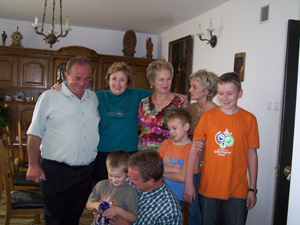 Marilyn and her cousins
Once again, we were warmly welcomed, fed, and made to feel at home, even though language problems were still acute. Before long, Maggie had returned from school and we had a chance, with her translation help, to tell them that we were studying family history. Well, this rang a big bell, and Maggie immediately produced a copy of her Master's Thesis, written in Krakow in 2000, for the Institute of European Historical Studies, entitled "Polish-Lemko in Labowa."
We stayed long enough to meet Maggie's father, Kazimierz, who was coming home from work, but
then we had to make the drive back to Sabinov in Slovakia. So we were invited back Sunday afternoon,
to visit with Maggie, her parents, her brother Robert, and four young children.
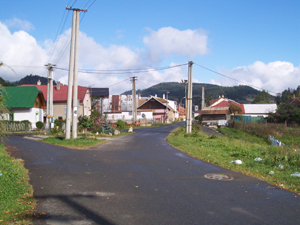 Entering Vysne Ruzbachy, Slovakia
Sunday morning we stopped in the village in Slovakia where Marilyn's (and Maggie's) great grandfather had started his family. While we searched through the graveyard for familiar names, Tom found the church, where a children's mass was in progress. The congregation had overflowed into the street, which we learned was fairly common in Slovakia. In some churches, loudspeakers broadcast the mass to those outside.
At Maggie's we talked about family, and then were fed a delicious lunch. For starters there was a large plate of pierogies with mouthwatering fillings of lentil, cabbage, potato, and buckwheat. These were far superior to those at the restaurant, which were already terrific! Let us merely say that we would happily return to Poland just for a taste of those pierogies.
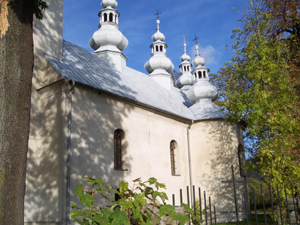 The Greek Catholic church
Then there was chicken soup with a clear broth, veal and potatoes and tomatoes and cucumber;
and several kinds of pastries. Maggie's mother walks just about every day to the forest to
pick mushrooms: we were given a taste of her pickled mushrooms which were delicious. Later
we reflected on the kind of specialized knowledge that is required to safely pick mushrooms in
the forest; in America we only buy those that are for sale in supermarkets.
The Greek Catholic church
Then there was chicken soup with a clear broth, veal and potatoes and tomatoes and cucumber;
and several kinds of pastries. Maggie's mother walks just about every day to the forest to
pick mushrooms: we were given a taste of her pickled mushrooms which were delicious. Later
we reflected on the kind of specialized knowledge that is required to safely pick mushrooms in
the forest; in America we only buy those that are for sale in supermarkets.
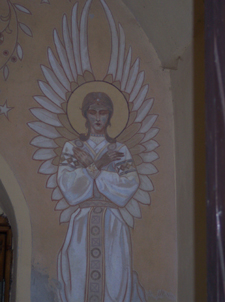 Angel, Greek Catholic church
Maggie told us about the Lemko, an ethnic subgroup found in Southeastern Poland, but which originated
in the western part of the Ukraine. The Lemko were Greek Catholics, and used a version of the
Ukrainian language which was similar to Polish and Slovak, but used the Cyrillic Alphabet, especially
in Poland. The Lemko were treated horribly under the communist regime; they were uprooted from their
homes and deported to northwestern Poland, to the lands that had been taken from the Germans (and
which had in turn been taken by the Germans from Poland when Poland was carved up between Germany and
Russia). If the father of a family was Lemko, the family was deported.
Angel, Greek Catholic church
Maggie told us about the Lemko, an ethnic subgroup found in Southeastern Poland, but which originated
in the western part of the Ukraine. The Lemko were Greek Catholics, and used a version of the
Ukrainian language which was similar to Polish and Slovak, but used the Cyrillic Alphabet, especially
in Poland. The Lemko were treated horribly under the communist regime; they were uprooted from their
homes and deported to northwestern Poland, to the lands that had been taken from the Germans (and
which had in turn been taken by the Germans from Poland when Poland was carved up between Germany and
Russia). If the father of a family was Lemko, the family was deported.
Labowa had a very large Lemko population, and many of Maggie's uncles and aunts had married Lemky. So some of her aunts were deported with their husbands. The Lemko policy had the result of tearing apart her family. Because of the ethnically prejudiced policy of the communists, "Lemko" has become a derogatory term to some. But Maggie's thesis explored the rich cultural traditions of these people, whose lives are so intimately entwined with her family.
Leaving the children to play, the adults embarked to the cemeteries once again, because here
indeed were the graves of Marilyn's and Maggie's great-grandparents. Jozef was buried in the Greek
Catholic Cemetery. Again, the original wooden cross had decayed, and the family had recently erected
an iron cross where the grave was located. Most of the gravestones in the Greek Catholic Cemetery were
inscribed in Cyrillic characters, indicating the Lemko cultural tradition.
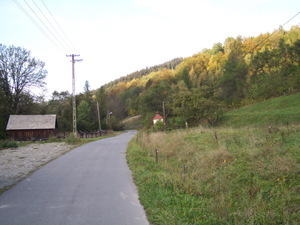 Deserted Lemko village
Kunegunda (for that was the name of Marilyn and Maggie's great-grandmother) had remarried after Jozef's death, and was buried with her second husband in the Roman Catholic Cemetery. We had missed the grave the first time through, because we did not know the surname of her second husband. In this cemetery, the custom is to ring the beautiful big bell when coming to visit.
We took a drive up a gentle winding valley into the hills, where an entire village of Lemko people had been located, now nearly a ghost town because of the deportations. We resolved to learn more about this ethnic group of western Ukrainians who had migrated to Poland and Slovakia.