 Bishop Hopko in Presov Cathedral
(1904-1976) and Paul Gojdich (1888-1960) who were imprisoned, placed on
starvation rations, and tortured under the communist regime in
Czechoslovakia. As a consequence, both men were beatified by Pope John
Paul II.
Bishop Hopko in Presov Cathedral
(1904-1976) and Paul Gojdich (1888-1960) who were imprisoned, placed on
starvation rations, and tortured under the communist regime in
Czechoslovakia. As a consequence, both men were beatified by Pope John
Paul II.
Hopko is not a common surname, and Hopko genealogies are rare. The only one we have found is listed in the catalog of the Family History Library in Salt Lake City, which is the primary library for family historians to send their work. According to the catalog notes, the early Hopko/Hobko family members lived in the Province of Rzeszow, which is the southeasternmost province of Poland.
Our cousins in Gregorovce told us that Basil Hopko, the bishop of the Greek Catholic diocese in Presov, used to visit Gregorovce -- they thought he was seeing his Hopko relatives. We decided to learn more about Bishop Hopko.
The Seminary and Cathedral of the Greek Catholic Church are in Presov. No
doubt this was where the Greek Catholic priest Jozef Maslej of Sarisske
Sokolovce had studied. We visited this beautiful cathedral on Monday,
and found our way to the two side chapels to the bishops Basil Hopko
Bishop Hopko in Presov Cathedral
(1904-1976) and Paul Gojdich (1888-1960) who were imprisoned, placed on
starvation rations, and tortured under the communist regime in
Czechoslovakia. As a consequence, both men were beatified by Pope John
Paul II.
Bishop Hopko was a Rusyn, or Lemko, from the small village of Hrabske, near the Polish border. Although we have established no firm genealogical connection to Bishop Hopko, it seems likely that the entire Hopko family is Lemko (or Carpatho-Rusyn).
The Carpatho-Rusyns are associated with the Greek Catholic religion, and
the wooden Greek Catholic churches of Eastern Slovakia are favorite tourist
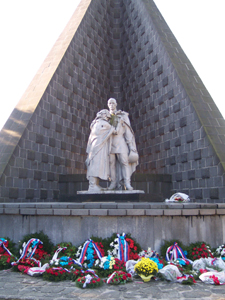 The Dukla Battle Memorial
attractions. We resolved to take a day trip eastward. (We had been warned
not to travel into the Ukraine; even our younger cousins left their cars at
the border and walked across to do their shopping. We will wait before making
such a trip.)
The Dukla Battle Memorial
attractions. We resolved to take a day trip eastward. (We had been warned
not to travel into the Ukraine; even our younger cousins left their cars at
the border and walked across to do their shopping. We will wait before making
such a trip.)
Tuesday morning Tom, Elsa, and Bob set out together, as Marilyn spent the day recovering from a bug. Our first destination was Dukla Pass, where there are the greatest concentration of wooden Greek Catholic churches, and also the scene of an important battle of World War II.
The Battle of Dukla Pass is not given much mention in American histories of
World War II, probably because few English-speaking soldiers fought there.
Nevertheless it was an important strategic objective for the Red Army in 1944,
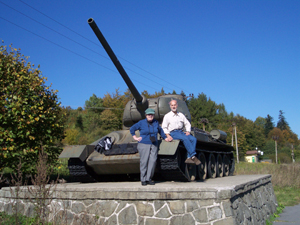 Elsa, Tom and Russian Tank
as it gave their armored divisions a clear avenue for the rush to Berlin.
The advancing armies included the Czechoslovak Army Corps under Brigadier
Ludvik Svoboda, who later became president of Czechoslovakia.
Elsa, Tom and Russian Tank
as it gave their armored divisions a clear avenue for the rush to Berlin.
The advancing armies included the Czechoslovak Army Corps under Brigadier
Ludvik Svoboda, who later became president of Czechoslovakia.
There were nearly 150,000 casualties in the battle, and the countryside was strewn with tanks, planes, and guns for years afterward. We found the pass a quiet and peaceful scene, spotted with monuments and some military equipment mounted on concrete platforms as memorials. The most moving display is the memorial and graveyard for the Czechoslovak troops at the top of the pass, adjoining the Polish border. There is a large observation tower, but it had already closed for the season.
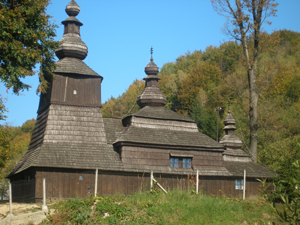 Wooden church at Mirola
We visited the wooden churches at Bodruzal and Mirola, situated just 6 kilometers
off the Dukla Pass road. Tom worked his customary magic and conjured up the
local representative of the Save The Wooden Churches organization to open the
17th century Greek Catholic church at Bodruzal.
Customarily the tallest bulb-shaped spire is over the entrance, the lowest
over the altar; the three towers signify the Trinity. The iconostasis, which
separates the congregation in the nave from the priests at the altar, is
illustrated with representations of the Trinity, the apostles, and the patron
saint of the church.
Wooden church at Mirola
We visited the wooden churches at Bodruzal and Mirola, situated just 6 kilometers
off the Dukla Pass road. Tom worked his customary magic and conjured up the
local representative of the Save The Wooden Churches organization to open the
17th century Greek Catholic church at Bodruzal.
Customarily the tallest bulb-shaped spire is over the entrance, the lowest
over the altar; the three towers signify the Trinity. The iconostasis, which
separates the congregation in the nave from the priests at the altar, is
illustrated with representations of the Trinity, the apostles, and the patron
saint of the church.
At the base of the Dukla Pass sits the town of Svidnik, which was burned
by the retreating German Army and is now rebuilt. We visited the Museum of
Ukrainian-Ruthenian Culture, where we encountered a young woman, Tatjana,
 Rusyn or Lemko migrations
who spoke English. She offered to go through the museum with us, leaving
her little sister with her mother.
Rusyn or Lemko migrations
who spoke English. She offered to go through the museum with us, leaving
her little sister with her mother.
The ethnic group has been known under the names Rusnaky, Ruthenians, Malorussians, Carpathorussians, Ugrorussians, Subcarpathian Rusyns, Lemkos, Ruthenian-Ukrainians, Ukrainians, etc. The migrations into Poland and Slovakia, extending into what is now the Czech Republic, took place in the 13th to 17th centuries (see map.) In the following years, the cultural characteristics of these immigrant peoples have slowly evolved to distinct subcultures in Poland and Slovakia.
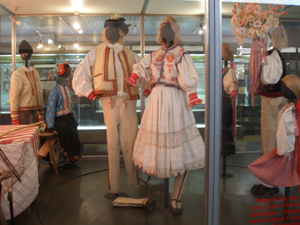 Svidnik Museum display
Ethnic groups eventually become diluted through intermarriage, as occurred
in Labowa, Poland, and in our Hopko family as well. The weakening of the
Lemko tradition in modern Poland and Slovakia is evidenced by the shift in
church attendance from the Greek to Roman Catholic, and from the Cyrillic
to the Roman alphabet. The ethnographer traces the cultural characteristics
such as building styles, clothing, tools, art, and folkways, all of which
were beautifully displayed in the museum.
We purchased a new book by Dr. Miroslav Sopoliga detailing the Ruthenian
culture in Slovakia.
We have made it a goal to translate this book, but this will no doubt be
a slow process.
Svidnik Museum display
Ethnic groups eventually become diluted through intermarriage, as occurred
in Labowa, Poland, and in our Hopko family as well. The weakening of the
Lemko tradition in modern Poland and Slovakia is evidenced by the shift in
church attendance from the Greek to Roman Catholic, and from the Cyrillic
to the Roman alphabet. The ethnographer traces the cultural characteristics
such as building styles, clothing, tools, art, and folkways, all of which
were beautifully displayed in the museum.
We purchased a new book by Dr. Miroslav Sopoliga detailing the Ruthenian
culture in Slovakia.
We have made it a goal to translate this book, but this will no doubt be
a slow process.
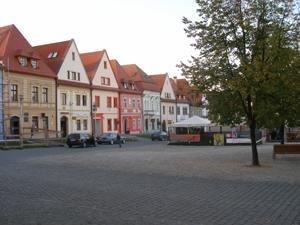 Bardejov plaza
We were not done with our trip! Bardejov is considered by many to be the
most beautiful town in Eastern Slovakia, and we travelled there to view its
huge open plaza surrounding the 16th century town hall and the Basilica of
St. Egidius.
After walking around the town and visiting
an unbelievable butcher shop with a wide array of sausages and cold cuts,
we spied the characteristic three spires of a Greek Catholic church.
"Hello," said a young lady as we walked toward the door. Of course we
greeted her in English and of course she offered to show us the Greek
Catholic church. This kind of warm help to tourists in Slovakia is
wonderful!
Bardejov plaza
We were not done with our trip! Bardejov is considered by many to be the
most beautiful town in Eastern Slovakia, and we travelled there to view its
huge open plaza surrounding the 16th century town hall and the Basilica of
St. Egidius.
After walking around the town and visiting
an unbelievable butcher shop with a wide array of sausages and cold cuts,
we spied the characteristic three spires of a Greek Catholic church.
"Hello," said a young lady as we walked toward the door. Of course we
greeted her in English and of course she offered to show us the Greek
Catholic church. This kind of warm help to tourists in Slovakia is
wonderful!
She explained that the Greek Catholic priests are encouraged to marry
before they take holy orders, that the iconostasis should be thought
 The Hopko memorial in Hrabske
of as writing, not painting, originally designed to explain the Bible
to illiterate parishioners, and that the Greek Catholic mass differed
in a number of particulars from the Roman Catholic mass, including the
priests' use of incense and walking behind the altar.
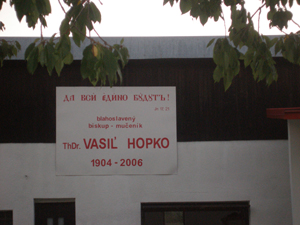
The Hopko memorial in Hrabske
of as writing, not painting, originally designed to explain the Bible
to illiterate parishioners, and that the Greek Catholic mass differed
in a number of particulars from the Roman Catholic mass, including the
priests' use of incense and walking behind the altar.
Leaving Bardejov, we stopped on the way home to see the village of Hrabske, birthplace of Bishop Hopko. The village was in the process of a building a beautiful shrine and visitor center in honor of their native son, but it was not yet open.
On the road to Hrabske we passed a gypsy village. A few permanent buildings
have been augmented by dozens of corrugated shacks. A dozen young boys played
stick hockey in the road. Later, in the twilight, we saw gypsies on their
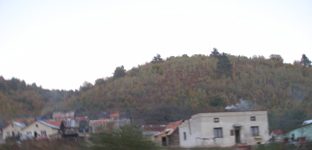 A Roma village
way back to this village stopping to harvest some potatoes from a field.
A Roma village
way back to this village stopping to harvest some potatoes from a field.
Gypsies, or Roma comprise about 5% of the population of Slovakia. They are the objects of adverse discrimination throughout Europe; their principal problems are poverty, unemployment, and crime. Having been protected by the paternalistic communist governments, gypsy welfare benefits were reduced by the emerging Eastern European democracies. With high birth and mortality rates, the average age and educational level of the gypsy population is low. The Decade of Roma Inclusion is an initiative launched in 2005 by nine central and southeastern European countries to improve the conditions of the Roma.