We had completed our self-assigned missions with great success. We had met new
cousins, made new friends, and learned to communicate with nouns, smiles, and
 A beautiful building facade
gestures. We had enjoyed brilliant autumn weather, eaten new and tasty foods
and drinks. We had walked on stones and walked through buildings which dated back
to the beginning of Christianity. We learned about the many forms of religion in
A beautiful building facade
gestures. We had enjoyed brilliant autumn weather, eaten new and tasty foods
and drinks. We had walked on stones and walked through buildings which dated back
to the beginning of Christianity. We learned about the many forms of religion in
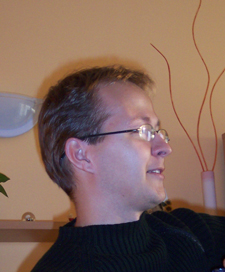 Another cousin - Marek
this part of Eastern Europe, and began to appreciate the strong presence of the
Catholic church. The very beginning of the Slovak nation was religious: when the
brothers Cyril and Methodius codified the Slovak language in the 9th century, and
the Slovak people achieved the right to hear mass in Slovak rather than Latin, two
of the most powerful characteristics of this nation were formed.
Another cousin - Marek
this part of Eastern Europe, and began to appreciate the strong presence of the
Catholic church. The very beginning of the Slovak nation was religious: when the
brothers Cyril and Methodius codified the Slovak language in the 9th century, and
the Slovak people achieved the right to hear mass in Slovak rather than Latin, two
of the most powerful characteristics of this nation were formed.
Throughout our visit, we saw the effects of language and religion. Berty
told us that when the Russians came, he was required to stop his study of English,
because English was considered "capitalistic". Now he is exercising a skill he
learned a half-century ago, and making sure the younger members of the family
study English as well.
We watched as church after church held daily masses to overflow crowds.
The churches were the first buildings in the towns to get funds for restoration
 Slovakia's White House
and rebuilding, after a generation in which they had been left to deteriorate.
Changing to a capitalist system was not easy for all; buildings had to be
repaired, employment was not guaranteed by the state, welfare was reduced.
Slovakia's White House
and rebuilding, after a generation in which they had been left to deteriorate.
Changing to a capitalist system was not easy for all; buildings had to be
repaired, employment was not guaranteed by the state, welfare was reduced.
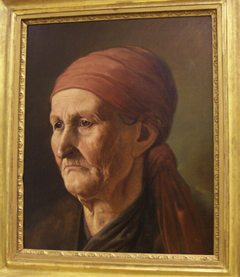 From the National Gallery
But by and large the Slovaks we met were happy with and proud of their country,
and eager to see the coming generations have the chance to achieve great things.
From the National Gallery
But by and large the Slovaks we met were happy with and proud of their country,
and eager to see the coming generations have the chance to achieve great things.
Returning to Bratislava, we met once more with Patrik and his brother
Marek, three years older, who had just purchased an apartment on the outskirts
of booming Bratislava. Patrik introduced us to the bus system, which was
remarkably well-regulated. Signs at the bus stop named the buses that stopped
there, the schedules, and the fares -- which for us had to be computed based on
the duration of our ride. Since we would be on the bus for more than 10 minutes
 God holding Jesus
but less than 30 minutes, we each had to pay 18 SKK, or 60 cents. The bus was
on time, the ride was smooth, young people stood to let us sit. Marek was eager
to hear the story of the American cousins, and happy to show us the beautiful
sunset from his apartment balcony.
God holding Jesus
but less than 30 minutes, we each had to pay 18 SKK, or 60 cents. The bus was
on time, the ride was smooth, young people stood to let us sit. Marek was eager
to hear the story of the American cousins, and happy to show us the beautiful
sunset from his apartment balcony.
Patrik also took us to the White House garden, where we took photos
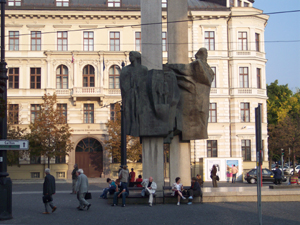 Typical massive Soviet art
against the backdrop of the President's home, which was built in the 1760s as
the summer residence of Count Anton Grasalkovic. Incidentally, Ivan Gasparovic
is the current president.
Typical massive Soviet art
against the backdrop of the President's home, which was built in the 1760s as
the summer residence of Count Anton Grasalkovic. Incidentally, Ivan Gasparovic
is the current president.
We enjoyed visiting the National Art Gallery and several smaller
galleries. Each one pleased us with well-displayed rooms with some outstanding
 Watching for celebrities
art. One work by a modern artist consisted of a black walkway across a mirrored
floor, with a mirrored ceiling; the walls were made out of stacks of books, and
the whole thing gave a most unsettling impression, as if the black walkway was
a bridge without railings over an unfathomably deep abyss.
Watching for celebrities
art. One work by a modern artist consisted of a black walkway across a mirrored
floor, with a mirrored ceiling; the walls were made out of stacks of books, and
the whole thing gave a most unsettling impression, as if the black walkway was
a bridge without railings over an unfathomably deep abyss.
Another gallery displayed ancient religious statues saved from now-destroyed
 "On our street is Freedom"
churches including the Virgin Mary, angels and altarpieces of various kinds.
One unusual sculpture shows God holding the dead body of Jesus.
"On our street is Freedom"
churches including the Virgin Mary, angels and altarpieces of various kinds.
One unusual sculpture shows God holding the dead body of Jesus.
We were so taken by the work of photographer Jindrich Streit that we
bought a book of his work, in the spirit of The Family of Man, by Henri Cartier-Bresson,
with whom Streit worked. During the Russian occupation, his exhibits of photos
of peasants and gypsies were conficated because they did not present a positive
image of peasant life.
Even the public art shows great variety. Massive Russian stone statues
contrast with the whimsical public bronze sculptures by Napoleon Cumil -- a
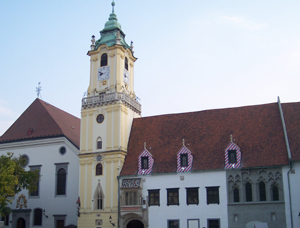 Bratislava's ancient town hall
paparazzi peers around a corner, an opera-goer doffs his hat, a Nazi emerges
from a manhole. At the Oracle software company building a new aluminum statue
to freedom was just installed.
Bratislava's ancient town hall
paparazzi peers around a corner, an opera-goer doffs his hat, a Nazi emerges
from a manhole. At the Oracle software company building a new aluminum statue
to freedom was just installed.
In the Town Hall museum we learned that city architects have found
evidences of habitation to the second millenium B.C. By the middle ages, wealth
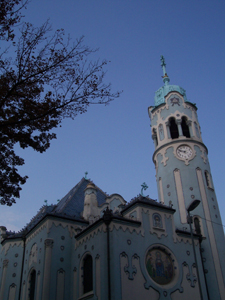 St. Elizabeth's church
and glory had come to Pressburg, as the city was then called. We passed through
rooms of beautiful furniture and objects of art, many of which came from mediaeval
guilds. The exhibit in the basement is a horrifyingly graphic display of punishment
and torture equipment and practices, still part of the town history. Youthful
Tom climbed to the top of the building's tower to see the view over Old Town;
the rest of us were warned off by the "ein-und-neunzig" steps.
St. Elizabeth's church
and glory had come to Pressburg, as the city was then called. We passed through
rooms of beautiful furniture and objects of art, many of which came from mediaeval
guilds. The exhibit in the basement is a horrifyingly graphic display of punishment
and torture equipment and practices, still part of the town history. Youthful
Tom climbed to the top of the building's tower to see the view over Old Town;
the rest of us were warned off by the "ein-und-neunzig" steps.
We met yet another Slovak who wanted to practice his English, a rather
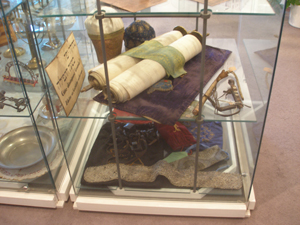 Torah scrolls
shabbily dressed older gentleman who enjoyed the view from his flat over the
Art Nouveau Blue Church of St. Elizabeth, talked of his son the doctor who
attended medical conferences in Los Angeles and Anaheim, and showed us his
membership card in an association of aircraft pilots.
Torah scrolls
shabbily dressed older gentleman who enjoyed the view from his flat over the
Art Nouveau Blue Church of St. Elizabeth, talked of his son the doctor who
attended medical conferences in Los Angeles and Anaheim, and showed us his
membership card in an association of aircraft pilots.
The Jewish Museum is located just around the corner from the Ibis.
It contains a broad collection of objects and clothing designed to explain
the customs and holidays of Judaism to visitors. There are memorials to those
 Zmrzlina!
lost in the Holocaust, but the museum does not detail that horror, although there
are books for sale on the subject.
Zmrzlina!
lost in the Holocaust, but the museum does not detail that horror, although there
are books for sale on the subject.
We continued to sample the Old Town restaurants, although we were chased
indoors, finally, by colder weather. Some younger patrons chose to stay outside
to watch the passing scene, wrapped in blankets thoughtfully provided by the
establishments.
And of course, before leaving Bratislava, we enjoyed one more zmrzlina!
What impressed us most was the warm friendly people we met, both in
Slovakia and Poland. What a precious asset! We look forward to a return trip.