The capital of the Slovak Republic is also its single major tourist destination.
Situated on the Danube River, just a short distance from Vienna, Bratislava
is accustomed to tourists from many countries. Tour buses and river boats
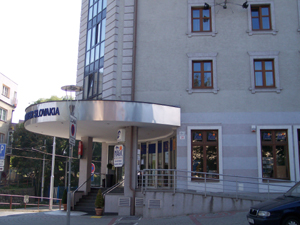 Our Bratislava hotel, the Ibis
stop at Old Town and discharge their human cargo along with tour guides
narrating in a variety of European languages. The Ibis Hotel, where we stayed,
is located next to Old Town, part way up the hill to the Hrad (which is Slovak
for Castle.) Tunnelling beneath the hill next to the Ibis are two fine
electric trolley lines - we soon became accustomed to the trolley wheels squealing
late at night!
Our Bratislava hotel, the Ibis
stop at Old Town and discharge their human cargo along with tour guides
narrating in a variety of European languages. The Ibis Hotel, where we stayed,
is located next to Old Town, part way up the hill to the Hrad (which is Slovak
for Castle.) Tunnelling beneath the hill next to the Ibis are two fine
electric trolley lines - we soon became accustomed to the trolley wheels squealing
late at night!
Our first expedition took us, slightly jet-lagged, down many steps to Old Town,
where we admired the seventeenth century St. Michael's Tower, part of the original
town walls. Old Town is crowded with designer boutiques, museums,
 Outdoor dining in Old Town
kiosks, outdoor
sculpture, restaurants with indoor and outdoor seating, courtyards, churches, and a
few buildings still being restored and developed. The heroic architecture is
reminiscent of Vienna, with each storey equal to one and a half stories of a modern
building. Statuary and decorations adorn the buildings. Bratislava was part of the
Habsburg Empire.
Outdoor dining in Old Town
kiosks, outdoor
sculpture, restaurants with indoor and outdoor seating, courtyards, churches, and a
few buildings still being restored and developed. The heroic architecture is
reminiscent of Vienna, with each storey equal to one and a half stories of a modern
building. Statuary and decorations adorn the buildings. Bratislava was part of the
Habsburg Empire.
At night Old Town is brightly lit. We were challenged by the narrow cobblestone
streets, but pronounced the food and drink very pleasant, and decided Old Town
was a good venue for people-watching.
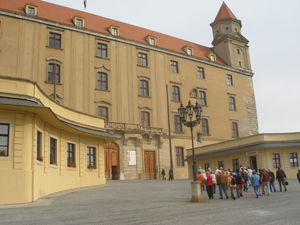 Entering Bratislava Hrad
The next full day we had time to explore the Hrad, which certainly provided an
effective defense of the riverfront and the walled city below. Today the castle
hill is home to the Slovak Parliament, highly desirable homes, upscale stores and
restaurants, while the castle itself houses a first-rate historical museum.
It's a massive building, with marble staircases and high-ceilinged rooms.
There are displays of old Turkish armor, reminding us that the Turks conquered
Bratislava (then called Pressburg) on their way to besiege Vienna -- where the
Ottoman Empire was finally stopped.
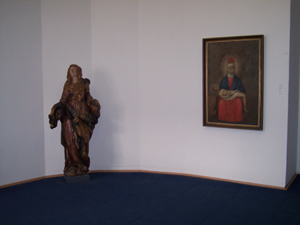 Some of the elegant religous art
There are wonderful displays of period
furniture, with exquisite joinery and ornate inlays.
Some of the elegant religous art
There are wonderful displays of period
furniture, with exquisite joinery and ornate inlays.
Much of the art is religious, and a special exhibit documented the Calvaries
of Slovakia, which were series of outdoor shrines, representing the Stations of
the Cross, and culminating with a hilltop shrine representing Calvary Hill.
Faithful Slovak Pilgrims would walk the path of the shrines each year. Many
of the Shrines are no longer standing -- victims of the Communist era. And so
we were given our first introduction to the intense rebirth of religion in
Eastern Europe after decades of suppression under Soviet domination. The
caption for the exhibit stated "... in the 50s all chapels and sculptures
were destroyed during the religious repression; only a few torsos today
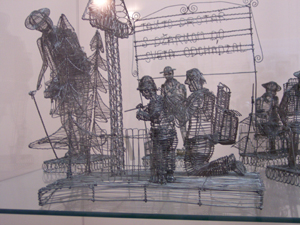 An example of Slovak wire art
parts of gallery expositions were lucky to survive thanks to several enthusiasts..."
An example of Slovak wire art
parts of gallery expositions were lucky to survive thanks to several enthusiasts..."
Perhaps our favorite special exhibit at Bratislava Hrad was the celebration
of the Slovak tinkers, whose tools and creations over 500 years were on display.
Tinkers walked from village to village, making repairs to household dishes and
baskets and selling their artistic creations, made from tin, silver, or even
gold wire. There was never enough work for a tinker to stay in a single village,
so "...when the son was born in the family of a tinker he was pushed out of
the window on a wooden bread baking shovel and they shouted 'to the world, my
dear, to the world', this should have predetermined him for long journeys
already from the cradle."
 Keeping up the diary entries
Then we watched a video of a modern wire artist and saw some stunning examples
of his work. It's not an art form that was familiar with us, and we were
fascinated at the expressive power of the wire sculptures.
Keeping up the diary entries
Then we watched a video of a modern wire artist and saw some stunning examples
of his work. It's not an art form that was familiar with us, and we were
fascinated at the expressive power of the wire sculptures.
We found that typing up our notes and labelling our pictures took several
hours at the end of each day; the two of us shared a single computer more
or less gracefully.
Our visit to the lovely museum at the Bratislava Hrad whetted our appetite
for Slovakia, and encouraged us to expect a lot from the museums and exhibits
we would be viewing in the next two weeks.