One night in 1903, three gentlemen from Springville, Utah, took a buggy ride to nearby
Provo to hear a lecturer tell how the fine arts can have a refining influence on people's
lives. They were so impressed that John Hafen, already an established artist, donated
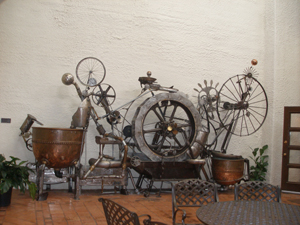 Water-powered installation
one of his paintings to the Springville high school in hopes that it would start an art
collection. Other Utah artists followed suit and by 1907 the original art collection
for the Springville Museum of Art was underway.
Water-powered installation
one of his paintings to the Springville high school in hopes that it would start an art
collection. Other Utah artists followed suit and by 1907 the original art collection
for the Springville Museum of Art was underway.
The high school took the lead in the development of the museum. They ran an "Art Queen"
contest: each vote cost a penny and you could vote as many times as you wished. The
money went for purchases of art, which the winning Queen unveiled. In 1921 the students
held their first annual Salon Exhibition patterned after the Paris Salon, which has
continued till this day.
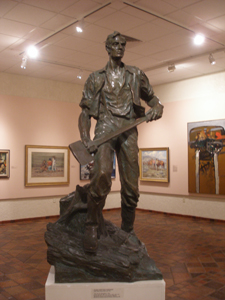 Young Abe Lincoln
By 1935 the museum collection was so large that a separate building was needed. Townspeople
raised $100,000 for the construction of a very attractive museum building, which was
completed in 1937 by the WPA.
We came upon this museum quite by chance: our AAA guidebook mentioned that its
collections include Soviet postwar art. We wondered how so many Soviet-era paintings
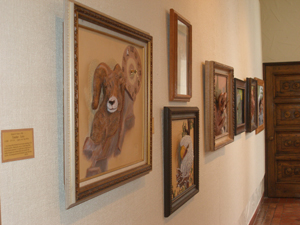 Three-D leather work
came to this city of 20,000 souls, so we stopped by. Arriving just at opening time,
we waited at the door for awhile, till a fellow visitor sought another entrance and
came through the building and let us in. This is an example of the friendly informality
of the place -- no entrance fee, few visible guards, but plenty of spacious galleries
well-filled with paintings and sculpture.
Three-D leather work
came to this city of 20,000 souls, so we stopped by. Arriving just at opening time,
we waited at the door for awhile, till a fellow visitor sought another entrance and
came through the building and let us in. This is an example of the friendly informality
of the place -- no entrance fee, few visible guards, but plenty of spacious galleries
well-filled with paintings and sculpture.
The greater part of the museum's collection is art by Utah artists, arranged more or
less chronologically. Most are representational works, sunny and warm landscapes,
 'Da Winnah'
portraits or story-telling paintings and sculptures. We especially liked the sculpture
of the young Abraham Lincoln, and were impressed by another sculpture, of the winner
and loser of a boxing match. Although, as the curator's card noted, "political satire
'Da Winnah'
portraits or story-telling paintings and sculptures. We especially liked the sculpture
of the young Abraham Lincoln, and were impressed by another sculpture, of the winner
and loser of a boxing match. Although, as the curator's card noted, "political satire
 1960 Presidential election
is rare" in Utah art, there was an interesting allegorical picture of the 1960 general
election, and a sharply drawn portrait of four card-playing women which we enjoyed.
1960 Presidential election
is rare" in Utah art, there was an interesting allegorical picture of the 1960 general
election, and a sharply drawn portrait of four card-playing women which we enjoyed.
We were pleased, given the constraints of the collection, to find so much variety.
Two large and complicated assemblages -- a flying machine and an elaborate concoction
of water-wheels, were fun and well-constructed. There were curiosities -- notably a
temporary exhibit of three-dimensional scenes made from leather -- and a surpringly
large number of surrealist works. One gallery featured a dazzling display of modern
digital art.
 Moldavians reading Pravda
But it was the Soviet art which most captured our attention. The museum director began
visiting the Soviet Union during the 1960s. From that time, he was able to purchase
paintings "at a reasonable price" according to the staff member who told us. This
collection represents works from mid-twentieth century forward and includes scenes
of workers, families, children, and some landscapes. We were reminded that artists
in the USSR had to be very careful to praise the Communist system; but now that the
USSR has fallen we found the heroic paintings of communist life to be fine art, despite
the politics.
Moldavians reading Pravda
But it was the Soviet art which most captured our attention. The museum director began
visiting the Soviet Union during the 1960s. From that time, he was able to purchase
paintings "at a reasonable price" according to the staff member who told us. This
collection represents works from mid-twentieth century forward and includes scenes
of workers, families, children, and some landscapes. We were reminded that artists
in the USSR had to be very careful to praise the Communist system; but now that the
USSR has fallen we found the heroic paintings of communist life to be fine art, despite
the politics.
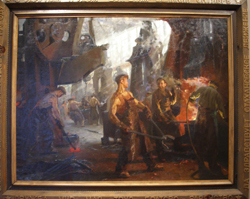 Soviet steelworkers
Why hadn't we heard about this museum before? It turns out that it is "America's largest
non-accredited art museum", so it doesn't make its way into standard museum listings.
Current plans call for the construction of a new wing and equipping the musem building
with the heating and air conditioning controls and access for physically impaired visitors,
as required for accreditation. Despite these technicalities, the museum is first rate,
and the town of Springville proudly bills itself as "Utah's Art City."
We encourage anybody passing through this part of the country to make a special detour
to the Springviille Museum of Art. For more information, see the website at
http://sma.nebo.edu/.