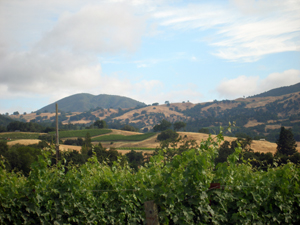
 Typical Sonoma County viewSonoma County, north of San Francisco,
is no exception; the possible explorations would keep the most industrious tourist occupied for many a day.
Typical Sonoma County viewSonoma County, north of San Francisco,
is no exception; the possible explorations would keep the most industrious tourist occupied for many a day.
One of California's major tourism specialties is Wine Touring, and for very good reason: It is impossible
to escape concentrations of vineyards in most rural areas of the state.
Typical Sonoma County viewSonoma County, north of San Francisco,
is no exception; the possible explorations would keep the most industrious tourist occupied for many a day.
The vineyards and wineries of the Alexander Valley in Sonoma County are, for the most part, tucked away on
picturesque side roads, where the pavement is narrow and cracked and the eucalyptus and oak and evergreen trees
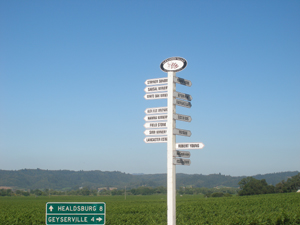 Typical Sonoma County view
provide year-round shade. At significant intersections, tall white signposts indicate which wineries (to be precise,
which tasting rooms) can be found on each road. In many cases, the vineyards are only partially connected to their
attached winery, since grapes are trucked all over -- and with the entrance of big boxes like Costco and Wal-mart
into the wine game, who knows where the grapes will end up?
Typical Sonoma County view
provide year-round shade. At significant intersections, tall white signposts indicate which wineries (to be precise,
which tasting rooms) can be found on each road. In many cases, the vineyards are only partially connected to their
attached winery, since grapes are trucked all over -- and with the entrance of big boxes like Costco and Wal-mart
into the wine game, who knows where the grapes will end up?
Most of the tasting rooms can be spotted from far away. Disguised as French country manors, the typical winery
visitor center rises above the vineyards usually behind a well-landscaped garden.
 Kendall-Jackson garden
In some cases the garden may be
the main attraction. For example, the small Matanzas Creek winery offers a lavender garden. Kendall-Jackson has,
in addition to a beautiful rose garden, a demonstration vineyard planted by the local junior college. The Ferrari-Carano
winery has perhaps the most elaborate garden, painstakingly planted and maintained, a most inviting entrance for visitors.
Kendall-Jackson garden
In some cases the garden may be
the main attraction. For example, the small Matanzas Creek winery offers a lavender garden. Kendall-Jackson has,
in addition to a beautiful rose garden, a demonstration vineyard planted by the local junior college. The Ferrari-Carano
winery has perhaps the most elaborate garden, painstakingly planted and maintained, a most inviting entrance for visitors.
But sometimes the winery is itself the attraction. Robert Young Estates welcomes visitors into an unassuming white barn-like
structure, where visitors may learn about the Robert Young Clone #17 and the development of its Chardonnay. Shades of Luther
Burbank! All vines are planted on mature, heat-treated (to discourage the phylloxera pest) root stock, but differ because of the different
vines grafted to this root stock.
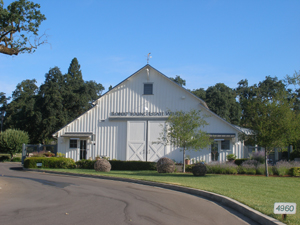 Robert Young Estates tasting room
The vines developed here became Clone #17 and sold to other vineyards, an unusual example of
identification of a specific quality. Robert Young Estates is currently being run by the four adult children of Robert Young
and are the fourth generation of farmers on this property.
Robert Young Estates tasting room
The vines developed here became Clone #17 and sold to other vineyards, an unusual example of
identification of a specific quality. Robert Young Estates is currently being run by the four adult children of Robert Young
and are the fourth generation of farmers on this property.
They think of themselves as farmers, carrying on the tradition of managing this land which began in the 1800s when the first
of the Young family planted a prune orchard. In the 1960s, following the advice of a county Farm Advisor, they joined the new
agricultural trend of growing grapes, first planting cabernet sauvignon grapes which are harvested later in the fall than the
prunes, then gradually shifting to all grapes. This kind of planning and strategic thinking is apparently a strong point of the
family. They have experimented with different methods of planting, fertilizing and harvesting their grapes.
 Summer vineyards
For example, when
the vines are thinned in the summer the potassium-rich cuttings are thrown to the ground on one side of each row, to be disced
into the soil for the following year, while the ground on the other side of each row has been planted with a nitrogen-rich grass
or bean crop. The Young son in charge of the vineyard, it is said, sleeps with a barometer on his nightstand; in case of a
drastic change in weather the alarm will wake him, and he can be in the fields in a matter of minutes.
Summer vineyards
For example, when
the vines are thinned in the summer the potassium-rich cuttings are thrown to the ground on one side of each row, to be disced
into the soil for the following year, while the ground on the other side of each row has been planted with a nitrogen-rich grass
or bean crop. The Young son in charge of the vineyard, it is said, sleeps with a barometer on his nightstand; in case of a
drastic change in weather the alarm will wake him, and he can be in the fields in a matter of minutes.
Their wines, both red and white, are delicious, to judge from the tasting room experience, but perhaps the most notable part of the visit was the opportunity to learn the details of the life of a grape-grower. It is a year-round, non-stop, intimate relationship with his fields.
Across Highway 101 from Alexander Valley to the west lies Dry Creek Valley, with remarkably different geography. The hills seem to lie closer together, the roads are even narrower, and the soils look different as well. Here is one of the oldest wine-growing areas in Northern California, dating back to Gold Rush days.
 Old grapevine stock
Despite the devastating double blow of a phylloxera epidemic about the same time as the beginning of Prohibition, a small number of wine
growers stayed on and others came to this fertile area, now well known for zinfandel as well as the usual assortment of red and white
wines. Nowadays, the variety of wine is surprising, with grapes like malbec, viognier, petit verdot, carignane.
Old grapevine stock
Despite the devastating double blow of a phylloxera epidemic about the same time as the beginning of Prohibition, a small number of wine
growers stayed on and others came to this fertile area, now well known for zinfandel as well as the usual assortment of red and white
wines. Nowadays, the variety of wine is surprising, with grapes like malbec, viognier, petit verdot, carignane.
A visitor to Dry Creek Valley will find a concentration of small wineries along several well-marked though challenging roads, and area maps are widely available. One noticeable change from other wine areas is that the grapevines look old -- thick central trunks support branches that, in many cases, spring out from all sides, unlike the more orderly-looking trellised rows.
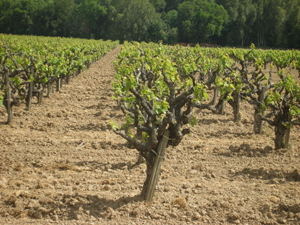 Single vines
This concentration of wineries is relatively recent, with many dating back only to the 1960s, although the vineyards themselves are
much older. Originally, the grapes were trucked to the large wineries in the Napa Valley and elsewhere.
Before wine was king, Dry CreekValley was one of the largest hop-growing areas in the United States.
The Martinellli orchards produced truckloads of apples for
Martinellli apple cider (no relation between families, they say). Signs from Santa Rosa to the Gravenstein Highway remind us of the vast
apple orchards which have since been displaced by vineyards. Occasionally tourists can find farmstands selling the produce of small truck
farms which retain their identity, not -- at least not yet-- joining the vineyard explosion.
Single vines
This concentration of wineries is relatively recent, with many dating back only to the 1960s, although the vineyards themselves are
much older. Originally, the grapes were trucked to the large wineries in the Napa Valley and elsewhere.
Before wine was king, Dry CreekValley was one of the largest hop-growing areas in the United States.
The Martinellli orchards produced truckloads of apples for
Martinellli apple cider (no relation between families, they say). Signs from Santa Rosa to the Gravenstein Highway remind us of the vast
apple orchards which have since been displaced by vineyards. Occasionally tourists can find farmstands selling the produce of small truck
farms which retain their identity, not -- at least not yet-- joining the vineyard explosion.