We followed the rain showers across the South. In Douglas, Georgia, we visited the tourist information of  Entrance to Shiloh Battlefield
the small town, in an imposing brick house. The Ashley-Slater House turned out to be the town's famous Haunted House, reliably scaring generations of Douglas children over the years. The first to die was a child of the businessman who had built the house. After the infant died from scarlet fever,the father went outdoors, cursed God, then took to his bed and died, becoming the second ghost to haunt the house. His widow was naturally cautious about making any changes, so she did not re-marry for many years. But her second husband, who was mentally unstable, stayed home from church one Sunday and went instead to the attic where he hanged himself. That is at least part of the story. The house is partially restored and looks beautiful
Entrance to Shiloh Battlefield
the small town, in an imposing brick house. The Ashley-Slater House turned out to be the town's famous Haunted House, reliably scaring generations of Douglas children over the years. The first to die was a child of the businessman who had built the house. After the infant died from scarlet fever,the father went outdoors, cursed God, then took to his bed and died, becoming the second ghost to haunt the house. His widow was naturally cautious about making any changes, so she did not re-marry for many years. But her second husband, who was mentally unstable, stayed home from church one Sunday and went instead to the attic where he hanged himself. That is at least part of the story. The house is partially restored and looks beautiful  Drummer Boys
with period furnishings and a dining room mural painted by an unknown traveling artist.
Drummer Boys
with period furnishings and a dining room mural painted by an unknown traveling artist.
This got us into the best of moods for exploring small towns across the country.
In Corinth, Mississippi we spent an afternoon fretting about the approaching tornado. Safe and secure in our hotel, we watched the sky darken and the wind pick up. On the advice of the desk clerk, we turned on the local television channel (Memphis) and watched the newsman give non-stop advice and warnings as he received weather updates. The storm was following a path which appeared to lead not only to Corinth but  Repurposed Bus Stop
exactly to the crossroads where we were located. We were advised to prepare to move into a hallway and put a pillow over our heads. Fortunately, the path of the storm changed a few miles west of us and turned north. The tornado actually touched down briefly about 10 miles west of us. It was an impressive introduction to the current (excellent) state of weather warnings in Tornado Alley.
Repurposed Bus Stop
exactly to the crossroads where we were located. We were advised to prepare to move into a hallway and put a pillow over our heads. Fortunately, the path of the storm changed a few miles west of us and turned north. The tornado actually touched down briefly about 10 miles west of us. It was an impressive introduction to the current (excellent) state of weather warnings in Tornado Alley.
Leaving Corinth, we headed into the forests and farms of the mid-South. We hadn't been driving long when we began to see signs for Shiloh Battlefield, a National Historic Site. Corinth had some Civil War 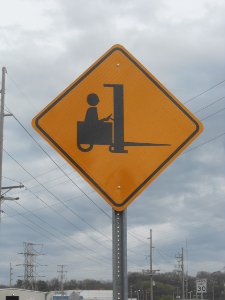 Beware the Fork Lift!
monuments, but nothing had mentioned Shiloh, so we thought we ought to see. We learned that Shiloh was the bloodiest battle in the West, and it led to the eventual capture of Vicksburg and the Mississippi River. Without the water transportation capability, the South was doomed.
Beware the Fork Lift!
monuments, but nothing had mentioned Shiloh, so we thought we ought to see. We learned that Shiloh was the bloodiest battle in the West, and it led to the eventual capture of Vicksburg and the Mississippi River. Without the water transportation capability, the South was doomed.
Participants at Shiloh, in addition to the 90,000-odd troops at war, included Brigadier Generals James Garfield and Major Generals William Sherman, Lew Wallace and Ulysses Grant, as well as Confederate Infantryman Henry Stanley ("Dr. Livingston, I presume?") and John Wesley Powell, the Western explorer.
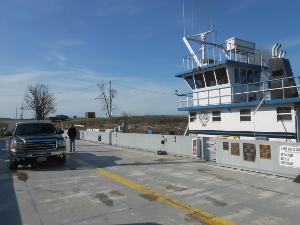 Our Personal Mississippi Ferry
Many of the exhibits were photos, some taken of the soldiers before the battle began. We were struck by picture of the young drummer boy because one of Elsa's ancestors, James Burnside, was about the same age when he marched off during the American Revolution.
In Dyersburg, our big discovery was the Bus Stop, a real Greyhound bus station lovingly restored and re-purposed into a sandwich shop. We also found a new addition to our sign collection, meaning caution - fork lifts about!
But our big adventure was another unexpected event. Those who have followed our travels know that we  The Missouri Shore
had tried to take a ferry across the Mississippi River not long ago, but when we reached the launch site there was no ferry to be seen, and no one who could tell us whether to expect one; we gave up and detoured to a bridge. This Spring we found ourselves on the road to Hickman, Kentucky, on the opposite side of the river from our previous trip. This time there were several signs pointing us to the place on the shore where the ferry (a barge with a push boat) was waiting. We were the only vehicle in sight, which didn't seem to bother the ferrymen at all. They waved us on board, took our fare, and set off for a pleasant crossing of the broad water. We feel happy that we were able to complete that particular trip, even by doing it in reverse. The Mississippi River is still filled with big floating logs which are a hazard to navigation, and the sight of a push boat guiding fifteen or twenty huge barges is breathtaking.
The Missouri Shore
had tried to take a ferry across the Mississippi River not long ago, but when we reached the launch site there was no ferry to be seen, and no one who could tell us whether to expect one; we gave up and detoured to a bridge. This Spring we found ourselves on the road to Hickman, Kentucky, on the opposite side of the river from our previous trip. This time there were several signs pointing us to the place on the shore where the ferry (a barge with a push boat) was waiting. We were the only vehicle in sight, which didn't seem to bother the ferrymen at all. They waved us on board, took our fare, and set off for a pleasant crossing of the broad water. We feel happy that we were able to complete that particular trip, even by doing it in reverse. The Mississippi River is still filled with big floating logs which are a hazard to navigation, and the sight of a push boat guiding fifteen or twenty huge barges is breathtaking.